Overview
Reliance Industries Limited is India's largest private-sector company and one of its most valuable. It began as a small trading firm and now spans oil refining and petrochemicals, mobile telecoms through Jio, India's largest retail business, and a new-energy arm. In the year to 31 March 2026 it reported consolidated revenue of ₹11,75,919 crore and profit after tax, including associates and joint ventures, of ₹95,754 crore, about US$10.1 billion. The company said it was the first Indian company to pass US$10 billion in annual net profit.
History
The company traces its start to 1958, when Dhirubhai Ambani, back in India after years at a trading house in Aden, set up Reliance Commercial Corporation in Bombay with his cousin Champaklal Damani. It traded spices and yarn from a one-room office. After the partnership ended, Dhirubhai opened a textile mill at Naroda, near Ahmedabad, in 1966 and made Vimal a household brand.
Reliance went public in 1977, and Dhirubhai's greatest financial innovation followed: persuading millions of middle-class Indians who had never owned a share to invest, and raising large sums through convertible debentures rather than relying only on state lenders. The company then integrated backwards into its own raw materials: polyester, petrochemicals and, eventually, refining. The Jamnagar refinery began operating in 1999 and has since grown into one of the largest refining complexes in the world.
Dhirubhai died in 2002 without a will. His sons Mukesh and Anil fought publicly over control until a 2005 settlement, brokered by their mother, Kokilaben, split the group. Mukesh Ambani kept Reliance Industries and its refining and petrochemicals core.
His defining bet was Jio. Launched to the public on 5 September 2016 with free voice calls and very cheap 4G data, it rapidly reshaped Indian telecoms and forced rivals to merge or exit. The launch was funded from Reliance's balance sheet, and by 2019 the group carried heavy debt. In 2020 Jio Platforms sold 32.97% of itself for about ₹1.52 lakh crore to investors led by Meta and Google. On 28 October 2026 Jio Platforms listed on India's stock exchanges after a ₹30,213 crore IPO made up entirely of new shares, with Reliance keeping 64.48%. Our article The Jio IPO and the Way Forward covers that listing in detail.
How the business works
Reliance is several large businesses under one listed parent. Oil-to-chemicals turns crude oil into fuels, polymers and polyester, and remains the group's biggest source of revenue; its earnings rise and fall with global refining margins. Digital services, through Jio Platforms, runs India's largest mobile network by broadband customers and earns steady, subscription-like income. Reliance Retail runs grocery, electronics, fashion and online stores across India. A new-energy business is building solar, battery and green-hydrogen manufacturing, and Reliance also produces gas from the KG-D6 offshore block and owns media assets.
The group's pattern is to build at very large scale from scratch, carry new businesses on the parent's balance sheet through a long ramp, and then bring in outside partners. That approach was used for Jamnagar, for Jio in 2020 and for Reliance Retail, which raised outside equity the same year. In 2025 it announced Reliance Intelligence, an artificial-intelligence subsidiary with partnerships involving Meta and Google Cloud.
Ownership and leadership
Reliance is listed on the National Stock Exchange and BSE, but it is family-controlled. According to its shareholding pattern filing, the promoter and promoter group held 50.44% at 30 September 2026, mostly through family-controlled entities. The rest was owned by about 5 million public shareholders, including foreign and domestic institutions.
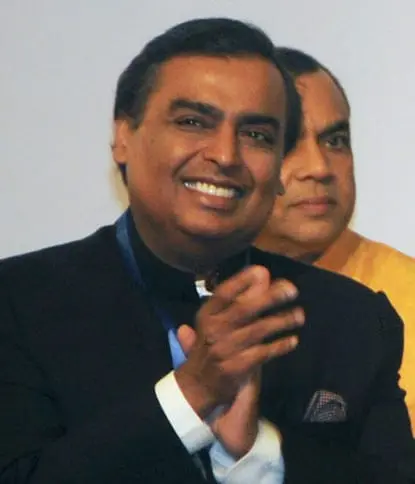
Mukesh Ambani has been chairman and managing director since 2002 and was reappointed in 2023 for a term running to April 2029. His children are on the board: Akash chairs Reliance Jio Infocomm, Isha leads Reliance Retail, and Anant became a whole-time executive director on 1 May 2025. The family led the Jio IPO, which has been widely read as part of a planned succession.
Controversies
PROVEN: the SEBI penalty on Ambani that was set aside. In 2021 the market regulator SEBI fined Reliance and Mukesh Ambani over 2007 trades in the shares of Reliance Petroleum. The Securities Appellate Tribunal set aside the penalty on Ambani personally in December 2023, and the Supreme Court declined to interfere in 2024, so that penalty does not stand.
DISPUTED: the KG-D6 gas-migration claim. The Indian government says gas from ONGC's neighbouring blocks migrated into Reliance's KG-D6 block. A 2018 arbitral tribunal ruled for Reliance and its partners, but a Delhi High Court division bench set that award aside in 2025, according to PTI. The petroleum ministry then issued a demand reported by Outlook Business at US$2.81 billion. Reliance and its partners have appealed to the Supreme Court, and no final ruling has found against them.
ALLEGED: historical and competitive claims. Journalism in the 1980s, notably by the Indian Express, alleged that policy changes favoured Reliance; many charges never became legal findings. In October 2026 Elon Musk accused Ambani of blocking Starlink, claims the Indian government rejected. India's competition regulator found no prima facie case in Bharti Airtel's 2017 complaint that Jio's free offers were predatory.
Why it matters
Reliance shows both sides of Indian capitalism at scale. It built a retail-investor culture, constructed world-scale industrial plants and made cheap mobile data part of daily life for hundreds of millions of people. It also concentrates great economic power in one family, which makes governance, related-party dealings and the treatment of minority shareholders central questions. For the founding story, read Dhirubhai Ambani: The Struggle, the Privilege, and the License Raj.