Overview
Anthropic makes Claude, a family of AI models used through chat apps, paid subscriptions, a developer API and the major cloud platforms. It was set up in 2021 by researchers who had left OpenAI, and its founding argument was that if powerful AI was going to be built anyway, it should be built by people who take its risks seriously. Five years on it is one of the two or three most valuable AI companies in the world. On 28 May 2026 it announced a $65 billion Series H round at a $965 billion post-money valuation and said its run-rate revenue had passed $47 billion.
That growth is the central tension in the company's story. A lab created partly to slow a reckless race now competes at the front of it.
History
Dario Amodei, a physicist who had been vice-president of research at OpenAI, left in 2021 with his sister Daniela Amodei and several colleagues, including Jared Kaplan, Jack Clark, Chris Olah, Ben Mann, Sam McCandlish and Tom Brown. They cited differences over direction, broadly how safely and how commercially OpenAI was developing ever more capable models. They incorporated Anthropic as a public-benefit corporation and later created a Long-Term Benefit Trust, a body meant to keep the mission ahead of shareholder interest in choosing the board.
The first Claude model launched in March 2023. Anthropic also developed Constitutional AI, a training method in which a model critiques and revises its own answers against a written set of principles, and funded a large research programme on interpretability, the study of what actually happens inside a neural network.
Money came in at a pace that matched the cost of training frontier models. Amazon committed about $8 billion across 2023 and 2024 and Google more than $1 billion. In 2025 the company's revenue began to climb steeply, driven largely by businesses and by programmers. A $13 billion round in September 2025 valued it at $183 billion; a $30 billion round on 12 February 2026 valued it at $380 billion, when run-rate revenue stood at $14 billion; and the May 2026 round more than doubled that again. HustleMemo's long read, Anthropic: The Safety Company That Had to Win, follows how that scale changed the company.
How the business works
Anthropic sells access to its models in three ways. Consumers and professionals pay monthly for Claude subscriptions. Businesses buy seats for their staff and pay for usage. Developers and companies pay per unit of text processed through the API, either directly or through Amazon Web Services, Google Cloud and Microsoft's cloud. Anthropic says Claude is the first frontier model available on all three.
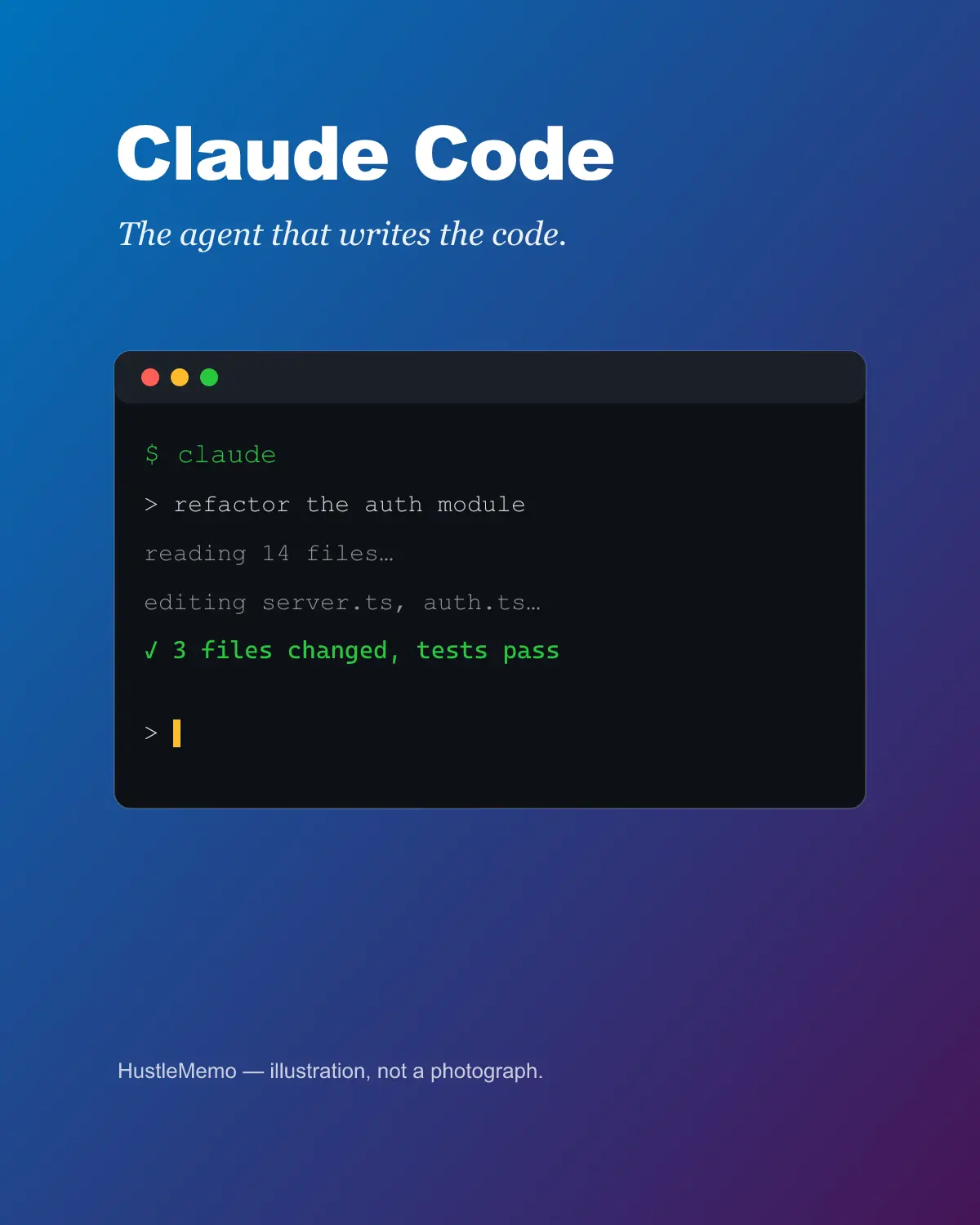
Coding has been the breakout use. Claude Code, an agent that works inside a developer's terminal, reading files, making edits and running tests across a whole repository, began as an internal prototype built by Boris Cherny and went into research preview in February 2025. By February 2026 Anthropic said it was earning at a run rate of more than $2.5 billion a year on its own. HustleMemo's article Claude Code: The Agent That Rewired Software Work explains how it moved the programmer's job from writing code to reviewing it.
The cost side is computing. The May 2026 announcement described commitments for up to five gigawatts of new Amazon capacity and five gigawatts of Google and Broadcom TPU capacity, plus access to GPU clusters run by SpaceX.
Ownership and leadership
Anthropic is private. It is owned by its founders, employees and investors, including Amazon and Google and funds such as Sequoia, Altimeter, Dragoneer, Greenoaks, Coatue and the Singapore sovereign fund GIC. None controls it. The Long-Term Benefit Trust, whose members hold no equity, elects a share of the directors. Dario Amodei is chief executive and Daniela Amodei is president.
Controversies
SETTLED: pirated books. Authors sued Anthropic after it emerged that pirated copies of books were among its training sources. A judge ruled in 2025 that training on lawfully bought books could be fair use but that keeping a library of pirated copies was not protected. Anthropic agreed in September 2025 to pay about $1.5 billion to settle, without admitting wrongdoing.
RESOLVED: FTX money. FTX invested about $500 million in 2022, before its collapse. The bankruptcy estate later sold the stake to repay creditors.
IN COURT: the Pentagon dispute. In late February 2026, after weeks of negotiations over military use of Claude, Defense Secretary Pete Hegseth moved to designate Anthropic a supply-chain risk, a label previously reserved for foreign adversaries; the formal notice followed in March. Anthropic said the dispute arose because it would not drop limits on uses such as mass domestic surveillance and fully autonomous weapons, and it called the move legally unsound. On 27 August 2026 a federal judge in California found the designation unlawful and retaliatory. In a separate case under a different law, the D.C. Circuit ruled for the Pentagon in September, and the department says the designation stands. Appeals are expected.
DISPUTED: the safety mission. Critics argue that raising money at this scale and racing rivals is the familiar path by which a safety mission becomes a growth mission. Supporters say influence over AI requires being at the frontier. HustleMemo's reporting finds evidence for both readings.
Why it matters
Anthropic is the clearest test of whether a company can be both a frontier AI developer and a careful one. It has published more safety research and discussed catastrophic risks more concretely than most rivals, while growing faster than almost any company in history. Its fights with the Pentagon and its governance structure will show what happens when those two goals pull apart. For the rival it was born from, see HustleMemo's profile of Sam Altman.