Overview
TechOvelpo is an Indian software-services company based in Bangalore. It designs, builds and launches web and mobile applications for clients, with a particular focus on startups, and it is the original business inside Fensso Tech LLP, the technology group that also includes the procurement platform Krayuv. Its website describes the company as "a passionate team of designers, developers, and strategists who understand the unique needs of startups."
TechOvelpo is small and privately held, and it does not publish revenue, headcount or client figures. This profile therefore sticks to what the company and its founders state publicly and what HustleMemo has reported from interviews, and it says so where a claim is the company's own.
History
The company began as Ovelpo Technologies Pvt Ltd. Divyansh Dixit registered it on 3 December 2019, during the final year of a B.Tech in Computer Science at a college in Ghaziabad. It started with four partners.
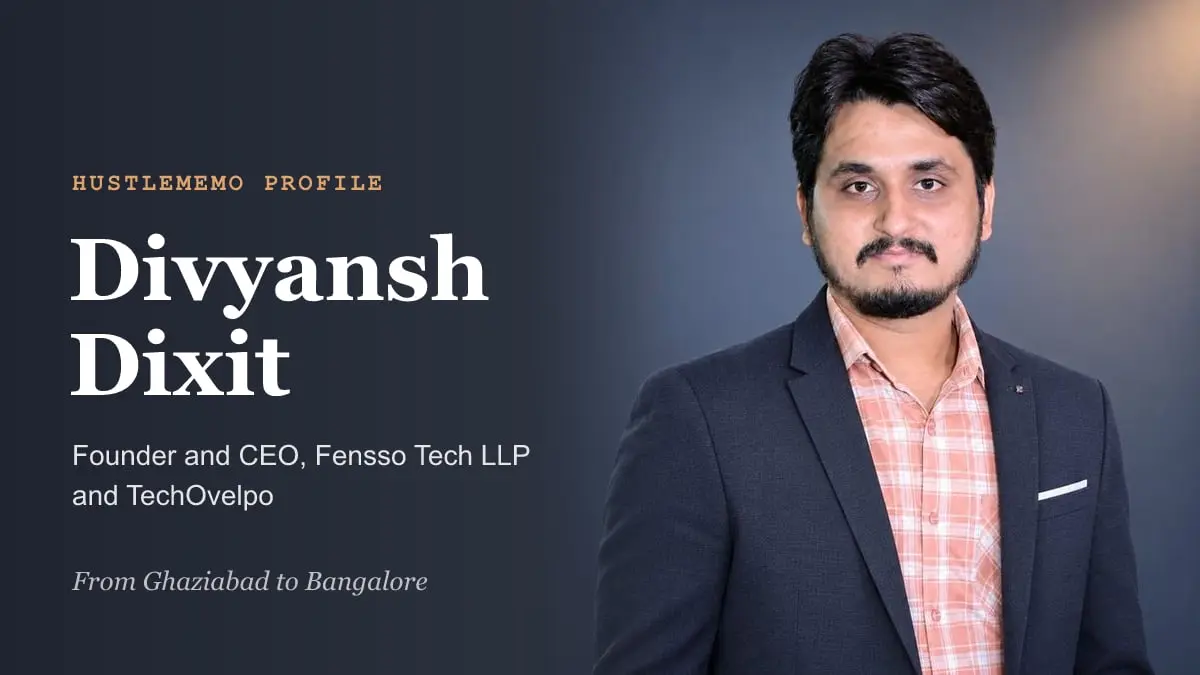
The timing was hard. The pandemic arrived within months, money ran short, and two of the four partners left. Divyansh Dixit and Shivansh Mishra stayed and kept the services business running. HustleMemo's profile of the founder, Building the Empire, From Ghaziabad to Bangalore, treats that period as the moment the company was decided, and it is the part of the story that both founders return to.
In the years that followed, Divyansh Dixit started other ventures alongside the services work, including wisetree.ai and songx.ai in 2022. In 2024 they set up Fensso Tech LLP as a parent company over those ventures, and Ovelpo Technologies was rebranded TechOvelpo the same year. The group's procure-to-pay platform, Krayuv, launched in 2025, and the project-management tool jiroboard followed the same year. TechOvelpo remains the group's software-development arm.
How the business works
TechOvelpo sells services, not a single product. Its website lists five areas:
- Design: UX and UI design and brand identity.
- Development: custom web and mobile applications.
- Deployment: launch, hosting and post-launch support.
- Talent acquisition: an internship programme that trains designers and developers, and placement of what the site calls "trained, vetted professionals" with client companies.
- Startup support: performance tracking, product updates and growth planning.
The site also offers developer subscriptions and pricing plans, a model in which a client pays a recurring fee for dedicated development capacity instead of contracting project by project. According to Divyansh Dixit's own profile, the company serves clients in India, the United States, the United Kingdom, Canada, Australia and the UAE, and it lists addresses in Bangalore, Sydney and Atlanta. The site does not name a fixed stack for the company, but the founders' own published skills centre on React, Next.js, React Native, Node.js, Python and cloud services.
The services business also feeds the rest of the group. Shivansh Mishra describes years of client work across fintech, e-commerce, edtech, healthcare and enterprise software, and that experience underpins the enterprise products Fensso is building. HustleMemo's article From Data Marts to a Product Portfolio traces that path.
Ownership and leadership
TechOvelpo is a private company within the Fensso Tech LLP group, which Divyansh Dixit and Shivansh Mishra set up in 2024. The website names Divyansh Dixit as co-founder and chief executive. Shivansh Mishra, the co-founder who stayed through the pandemic, works across product strategy, architecture, delivery and client relationships in the group. The company does not publish a shareholder breakdown or financial accounts on its site.
Divyansh Dixit also holds roles outside the group, as chief technology officer of a healthtech company and vice-president of IT at an HR firm. Those are separate businesses.
Why it matters
TechOvelpo is an example of a pattern common in Indian technology: a services company that keeps the founders alive and paid, and then becomes the base from which they build products. Its story is not a funding story. It began with no outside capital in a founder's final college year, survived losing half its partners, and now sits beneath a group trying to build enterprise software for the Indian market.
Divyansh Dixit has also written about what he has seen from the services side of startup work. His HustleMemo essay The Startup Delusion argues that many young companies spend on titles, hierarchy and headcount before they have the business to support them, an argument shaped by years of working with clients as their technology partner.