Shahid Khan: The Bumper, the Bootstraps, and the Billions
From a $1.20-an-hour dishwasher to an NFL owner on a real product he engineered — and the public subsidies and leverage the bootstraps myth leaves out. A fact-checked profile.
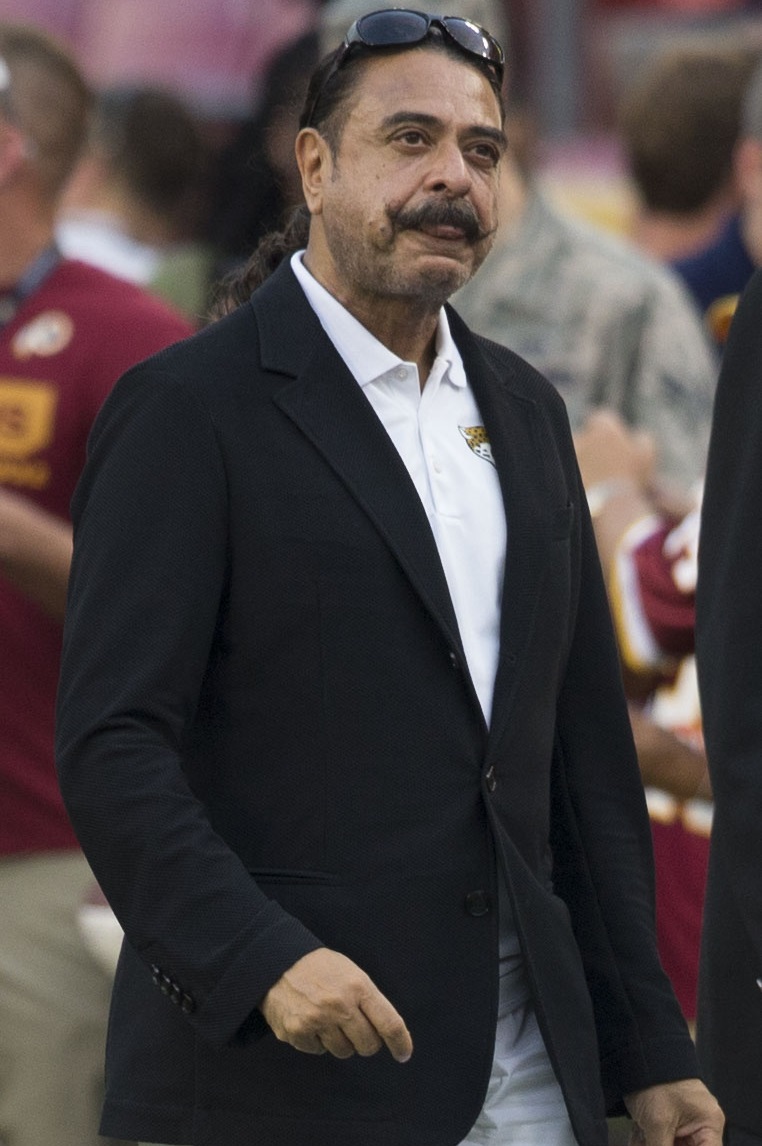
If Mian Muhammad Mansha is the case study in how proximity to the state builds a fortune, Shahid Khan is the opposite archetype — the one the American immigrant myth was practically written for. He arrived in the United States with a few hundred dollars, washed dishes for just over a dollar an hour, bought the company that had employed him, and turned a single clever piece of bent metal into one of the largest privately held manufacturing businesses in North America, an NFL franchise, an English football club, and a fortune in the tens of billions. It is a genuinely extraordinary story. It is also worth examining honestly, because even the cleanest bootstraps narrative, looked at closely, rests on advantages and trade-offs the highlight reel leaves out.
The arrival
Shahid Khan was born in 1950 in Lahore, in what was then a three-year-old Pakistan, into a middle-class family — his father ran a surveying and printing business. In 1967, at sixteen, he travelled to the United States to study industrial engineering at the University of Illinois at Urbana-Champaign. The often-repeated detail is true and telling: his first night in America he slept at the YMCA for under two dollars, and he worked his way through college washing dishes for around $1.20 an hour, which to him felt like real money compared with what was available back home. He has spoken about the shock and the freedom of it — the sense that here, what you built was more or less what you got to keep, a stark contrast to the patronage-bound economy he had left.
It is the textbook immigrant launch, and it is real. But note the structure underneath it: he came from a family that could send a son abroad to study engineering at a major American university in 1967 — itself a meaningful advantage over the overwhelming majority of Pakistanis of his generation, much as with Mansha. The poverty of the dishwashing years was real but temporary, scaffolded by an education and a family that made it a launchpad rather than a trap. The myth says "he had nothing." The truth says "he had little cash and a great deal of opportunity," and the distinction matters because it is the opportunity — the visa, the university place, the engineering degree, the world's richest consumer market on the other side of graduation — not the hardship, that did the heavy lifting. Hardship makes a good story; opportunity makes a fortune.
The bumper that built a billionaire
After graduating, Khan went to work for Flex-N-Gate, an automotive-parts manufacturer in Illinois, while still a student, and rose into management. In 1980, with his savings and a loan backed by the U.S. Small Business Administration, he bought the company outright. This is the pivot the whole empire turns on — and the substance of his genuine engineering talent.
Khan had already, in the 1970s, designed a one-piece, seamless, dent-resistant car bumper, replacing the multi-piece bumpers that had been standard. It was a real product innovation: cheaper to manufacture, stronger, lighter, and corrosion-resistant, made from a single sheet of galvanised steel. Through his company Bumper Works, he won the business of Toyota — a relationship that became a masterclass in lean manufacturing, as Khan absorbed Japanese production methods and applied them ferociously — and then the Detroit automakers. He became a dominant supplier of bumpers for pickup trucks and SUVs at exactly the moment those vehicles came to dominate American roads, a piece of timing that turned a good business into an enormous one.
Flex-N-Gate grew into one of the largest private companies in the United States, with tens of thousands of employees, dozens of plants across North America and beyond, and revenues that climbed into the billions. Unlike fortunes built on financial engineering or state favour, this one was built on a physical product that was genuinely better and a manufacturing operation he ran with relentless, famously hands-on cost discipline. Khan did not simply own Flex-N-Gate; he engineered it, walked its plant floors, and obsessed over its production efficiency for decades. That deserves unqualified credit, and it is the part of his story that genuinely separates him from the inheritance-and-access archetype.
From the factory floor to the owner's box
Having made his fortune quietly in auto parts, Khan spent it loudly in sport. In 2011 he bought the Jacksonville Jaguars of the National Football League for a reported US$770 million, becoming the first member of an ethnic minority to own an NFL team — a milestone that carried real symbolic weight in a league whose ownership ranks had been almost uniformly white. In 2013 he bought Fulham Football Club in London for a reported sum in the £150–200 million range, later overseeing its yo-yo journey between the Premier League and the Championship and a major redevelopment of its Craven Cottage stadium. He backed his son Tony Khan's launch of All Elite Wrestling in 2019, bankrolling the most serious challenge in decades to the WWE's near-monopoly on American professional wrestling. By the mid-2020s his net worth was estimated at well over US$12 billion, placing him among the richest people of Pakistani origin anywhere in the world.
He became, in the process, something rare: a Pakistani-American immigrant celebrated on two continents, equally at home in a Jacksonville stadium and a London boardroom, his handlebar moustache and his rags-to-riches arc functioning as a marketing asset in their own right. He leaned into the story, and the story was true enough to bear the weight.
Where the myth meets the ledger
A critically neutral profile cannot stop at the inspirational arc, because the sports-ownership chapter is exactly where the self-made narrative collides with the ordinary realities of how billionaires operate — and Khan, for all his evident likeability, operates like a billionaire.
The clearest example is the economics of his NFL franchise. Like nearly every American sports-team owner, Khan has pursued large public subsidies for stadium infrastructure — most notably a multibillion-dollar "Stadium of the Future" redevelopment of Jacksonville's stadium, agreed in 2024, with a very substantial share of the cost — hundreds of millions of dollars — borne by the city's taxpayers. This is standard practice in American professional sport, where owners routinely extract public money by leveraging the implicit threat of relocation, and it is not unique to Khan. But it sits awkwardly against the bootstraps legend: the same man whose brand is "I needed no help from anyone" has, as an owner, sought enormous sums of public money to upgrade the home of a privately owned, highly profitable franchise whose value has more than tripled since he bought it. That is not a scandal; it is simply how the league works. But it is a necessary corrective to the idea that his success exists outside the systems of leverage and subsidy that the wealthy everywhere rely on.
His stewardship of the Jaguars has also strained the relationship the myth implies. The team's repeated staging of "home" games in London — part of Khan's transatlantic ambitions, which included a 2018 attempt to buy Wembley Stadium for a reported £600 million that he ultimately withdrew amid opposition — has periodically alarmed Jacksonville fans who fear their mid-sized city is being treated as a way station to a more lucrative market. The tension is real: a fan base's loyalty is not a tradeable asset to the people who hold it, but to an owner it is one input among many in a global revenue calculation.
And as with any manufacturer of his scale, Flex-N-Gate operates in an industry where cost discipline, workplace safety, and labour conditions are perennial points of tension. Running one of the largest auto-parts firms in America at the margins Khan does is not achieved without hard, sometimes contested, choices on the factory floor; large parts manufacturers across the sector have faced safety citations and labour disputes over the years, and the relentless efficiency that built the fortune is, from the shop floor, experienced as relentless pressure. None of this is unique to Khan, and none of it is fraud — but it is the unglamorous underside of "ran it with relentless cost discipline," and an honest profile names it.
The making of an engineer
It is easy to skip past the University of Illinois years as a montage — dishwashing, study, graduation — but they are where the actual capability was forged, and they complicate the pure bootstraps reading in a useful way. Khan did not arrive in America with a fortune, but he arrived inside one of the great engineering pipelines of the twentieth century: a top-tier American public research university, in a country whose automotive industry was the largest and most sophisticated on earth, at a moment when manufacturing know-how was the surest ladder into the middle and upper class. The grind was real; so was the platform under it.
He studied industrial engineering — the discipline of making production more efficient — which turned out to be precisely the training the rest of his life would reward. While classmates pursued more glamorous fields, Khan went to work in the unglamorous business of bending metal for cars, and he understood it not as a job but as a system to be optimised. The famous one-piece bumper was not a flash of inspiration but the product of an engineer's habit of looking at a standard, multi-part assembly and asking why it had to be that complicated, that heavy, that prone to rust. The answer — that it didn't — was worth a fortune because Khan had the specific technical training to see it and the manufacturing grit to produce it at scale and on cost. The lesson buried in the legend is that opportunity and preparation had to meet: the American manufacturing economy supplied the opportunity, and an Illinois engineering education supplied the preparation. Strip away either and there is no empire.
What Toyota taught him
The deepest substance of Khan's success — the part that separates him from a lucky inventor — is manufacturing discipline, and its source is worth dwelling on because it is genuinely instructive. When Bumper Works won Toyota's business in the 1980s, Khan did not simply ship parts; he was pulled into the orbit of the Toyota Production System, the lean-manufacturing philosophy that was then revolutionising global industry. Toyota's engineers were notoriously demanding of their suppliers, drilling them on inventory, defect rates, changeover times, and continuous improvement. Khan, by his own account, treated it as an education rather than an imposition.
He absorbed the lessons and applied them with an intensity that became his signature: relentless attention to the cost of every part, every motion, every minute of plant downtime. This is the unglamorous engine of the fortune. The bumper got him in the door; lean manufacturing, ferociously executed across dozens of plants, is what let Flex-N-Gate keep winning contracts on razor-thin margins while competitors faltered. It is also, viewed from the other side, what makes large-scale parts manufacturing a high-pressure place to work — the same discipline that delights an automaker's procurement department is felt as unyielding intensity on the line. Both things follow from the same source.
Fulham, Craven Cottage, and the football education
If the NFL purchase was a statement of arrival, Fulham was an education in a different sport's economics. Khan bought the West London club in 2013 and quickly learned how unforgiving the English football pyramid is: Fulham bounced between the Premier League and the Championship, the promotion-and-relegation system punishing every miscalculation with tens of millions of pounds in lost broadcast revenue. He invested heavily, including a costly and at times controversial redevelopment of the Riverside Stand at the historic Craven Cottage ground, transforming it into a luxury-tier venue with riverside hospitality — a project that drew both admiration for its ambition and grumbling about the gentrification of a beloved old stadium.
Fulham revealed the limits of even a billionaire's control. In American sport, with its closed leagues, salary structures, and guaranteed franchise values, an owner's downside is cushioned. In English football, there is no such floor: spend badly and you are relegated, and the asset you paid for is suddenly worth a fraction of the price. Khan navigated it competently rather than spectacularly, and in doing so demonstrated that his genius is specific — manufacturing and patient capital allocation — rather than a magic touch that transfers to any arena.
The AEW bet and the Khan dynasty
The third act of Khan's spending tells you something about how he thinks about legacy. In 2019 he bankrolled All Elite Wrestling, the venture his son Tony Khan had dreamed up, to challenge WWE's decades-long stranglehold on American professional wrestling. It was, on paper, a strange bet for an auto-parts billionaire: a money-losing entertainment start-up in an industry dominated by a single entrenched incumbent. But it was also a calculated piece of dynasty-building — handing the next generation a real company to run, in a business it was passionate about, much as the great family houses of South Asia hand divisions to their heirs.
The wrestling gamble has been genuinely disruptive, securing a major television deal and proving that a well-funded challenger could carve out market share against an entrenched monopolist. It has also burned cash and drawn the familiar criticism that it is a rich man indulging his son's enthusiasm. Both readings have merit. What the AEW chapter reveals is the same instinct visible in the Jaguars and Fulham: Khan does not collect trophy assets for status alone; he treats them as operating businesses and as inheritances, vehicles for turning a self-made fortune into a family institution that will outlive him. The dishwasher who arrived in 1967 is, in his seventies, doing what dynasts do.
The symbolism, and its uses
It is impossible to discuss Khan without acknowledging what he represents. A Muslim immigrant from Pakistan, sitting in an NFL owner's box — a club whose members had been almost uniformly white, wealthy, and American-born — is a genuinely meaningful image in a country where anti-immigrant and anti-Muslim sentiment is a live political force. Khan has, at moments, used that platform deliberately, including visible gestures of solidarity with his players during national debates over race and protest. For many Pakistani-Americans and immigrants more broadly, he is a source of real pride, proof that the door is not entirely closed.
The critically neutral observation is simply that symbolism is also an asset, and Khan, a brilliant marketer of his own story, knows it. The moustachioed self-made immigrant is a brand, deployed in service of franchises, sponsorships, and goodwill. That does not make the symbolism hollow — representation matters, and his is real. It means only that, as with everything about him, the inspiring surface and the commercial machinery beneath it are the same object viewed from two angles. He is a genuine immigrant success and a sophisticated operator who understands the market value of being one. Keeping both in view is the whole discipline of reading a figure like Khan honestly.
Scale, and the next disruption
The quiet core of the empire remains Flex-N-Gate, and its scale is easy to underestimate precisely because it is invisible to consumers. The company makes bumpers, lighting, structural metal and plastic components for vehicles that millions of people drive without ever knowing whose parts hold them together. It operates dozens of plants across North America and beyond, employs tens of thousands, and generates revenues that dwarf the headline-grabbing sports purchases. The Jaguars and Fulham are the famous part of Khan's wealth; Flex-N-Gate is the engine that paid for them.
That engine now faces the same disruption shaking the entire automotive supply chain: the shift to electric vehicles, which have fewer parts, different structures, and a brutally cost-competitive supplier landscape increasingly shaped by China. A fortune built on internal-combustion-era components is not automatically safe in an EV world, and the discipline that built Flex-N-Gate will be tested by a transition that rewrites which parts a car even needs. How Khan and his successors navigate that — whether the lean-manufacturing edge transfers to a transformed industry — is the open commercial question hanging over the empire's second half-century. It is a reminder that even the most genuinely self-made fortune is never finished, only between challenges.
A tale of two Pakistanis
It is illuminating to set Khan beside Mansha, the other titan of Pakistani business, because together they map the two roads to a great fortune. Mansha stayed, inherited, and mastered the state; Khan left, started near the bottom, and mastered a product inside the world's deepest market. Mansha's wealth is inseparable from Pakistani policy — privatised banks, guaranteed power returns, protected industries. Khan's is inseparable from American opportunity — the university place, the SBA loan, the consumer market, the NFL. Neither man is purely self-made; both started with the decisive advantage of a family that could fund an elite education. But the systems they exploited could hardly be more different, and the contrast is itself the lesson: the same Pakistani middle-class starting point produced a state-proximate conglomerate in one country and a product-driven manufacturing empire in another. Geography, and the kind of economy you plug your talent into, shaped the fortune at least as much as the talent did.
The honest verdict
Shahid Khan's story is the genuine article in a way Mansha's is not: his core fortune rests on a product he engineered and a company he built and ran for decades, not on a privatised bank or a guaranteed-return licence. The dishwashing-to-billions arc is true, the bumper was real, and a Pakistani teenager who arrived at a YMCA in 1967 and ended up owning an NFL team is a legitimately remarkable life that no amount of caveat can diminish.
But "self-made" remains, as ever, a half-truth that flatters everyone who repeats it. Khan started with the decisive advantage of a family that could fund an American engineering degree, built his manufacturing empire inside the world's richest consumer market, and now operates — in sport especially — with exactly the appetite for public subsidy and market leverage that defines the billionaire class he joined. The accurate sentence, as so often, has two clauses: he built something genuinely his, and he did it from a starting line, and inside a system, that most of the people inspired by his story will never get to stand on. Both halves are true, and the inspiration is more useful — more honest, and more usable — when you keep them together.
Editor's note: HustleMemo writes founder-led case studies grounded in public reporting. We credit genuine product innovation where it exists and separately examine the public-subsidy and labour realities of large-scale ownership; sector-wide labour and safety tensions are described as such, not as specific adjudicated findings against the subject. Corrections: editorial@hustlememo.com.
Sources
- "Shahid Khan," Wikipedia (born 1950 Lahore; arrived in the US in 1967; University of Illinois; bought Flex-N-Gate in 1980 with an SBA-backed loan; one-piece bumper innovation and Bumper Works; Jacksonville Jaguars 2011 for ~$770M; Fulham FC 2013; All Elite Wrestling 2019; net worth >$12B).
- Reporting on Flex-N-Gate's scale as one of the largest privately held US companies and its automotive-supply business and Toyota relationship.
- Coverage of the Jacksonville Jaguars' London games, the 2018 Wembley Stadium bid and its withdrawal, and the 2024 Jacksonville "Stadium of the Future" public-funding agreement.
- General industry reporting on workplace-safety and labour conditions across large US auto-parts manufacturing (described as sector-wide context, not specific findings against the subject).
More from this category
Aliko Dangote: The Trader Who Built Africa’s Biggest Industrial Empire
A critically-neutral profile of Aliko Dangote: heir to a trading dynasty who built Africa’s biggest industrial empire through backward integration and scale, rode Nigeria’s protectionist policy, bet ~$20bn on a giant refinery — and faces genuine, unresolved questions about market concentration and government ties.

Sir Brian Souter: Stagecoach and the Fortune Built on a Policy
Sir Brian Souter co-founded Stagecoach and turned the deregulation of Britain’s buses into a transport empire. A sourced, critically neutral look at genuine industrial achievement, the proven "predatory" competition findings, the controversial "Keep the Clause" campaign, and the disputed claims about his SNP donations.
Andrew Carnegie: Steel, the Gospel of Wealth, and Homestead
Andrew Carnegie rose from a penniless Scottish immigrant boy to the master of American steel, sold out to J. P. Morgan for $303.45M, and gave away roughly 90% of his fortune. A sourced, critically neutral case study that holds his vast philanthropy and the violent 1892 Homestead Strike together, without resolving the contradiction.