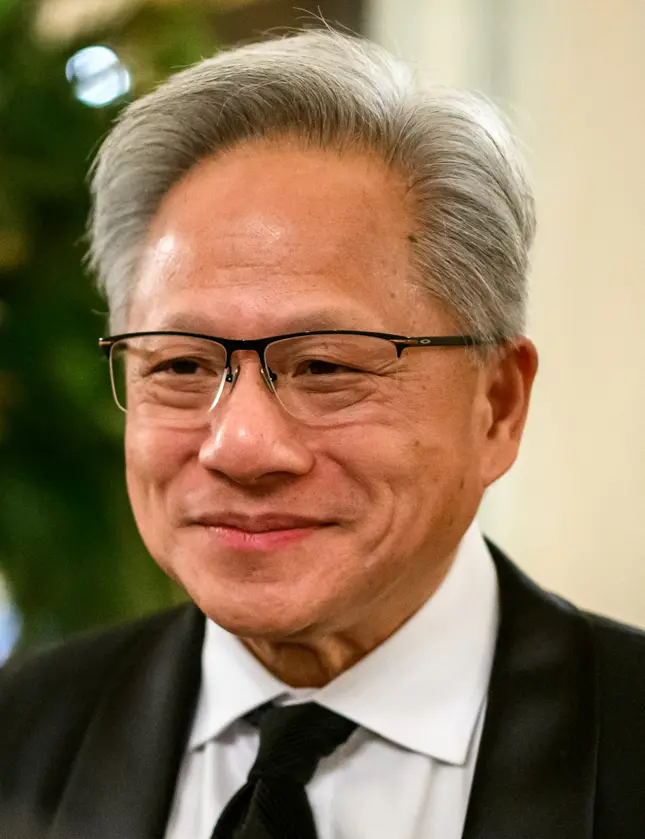
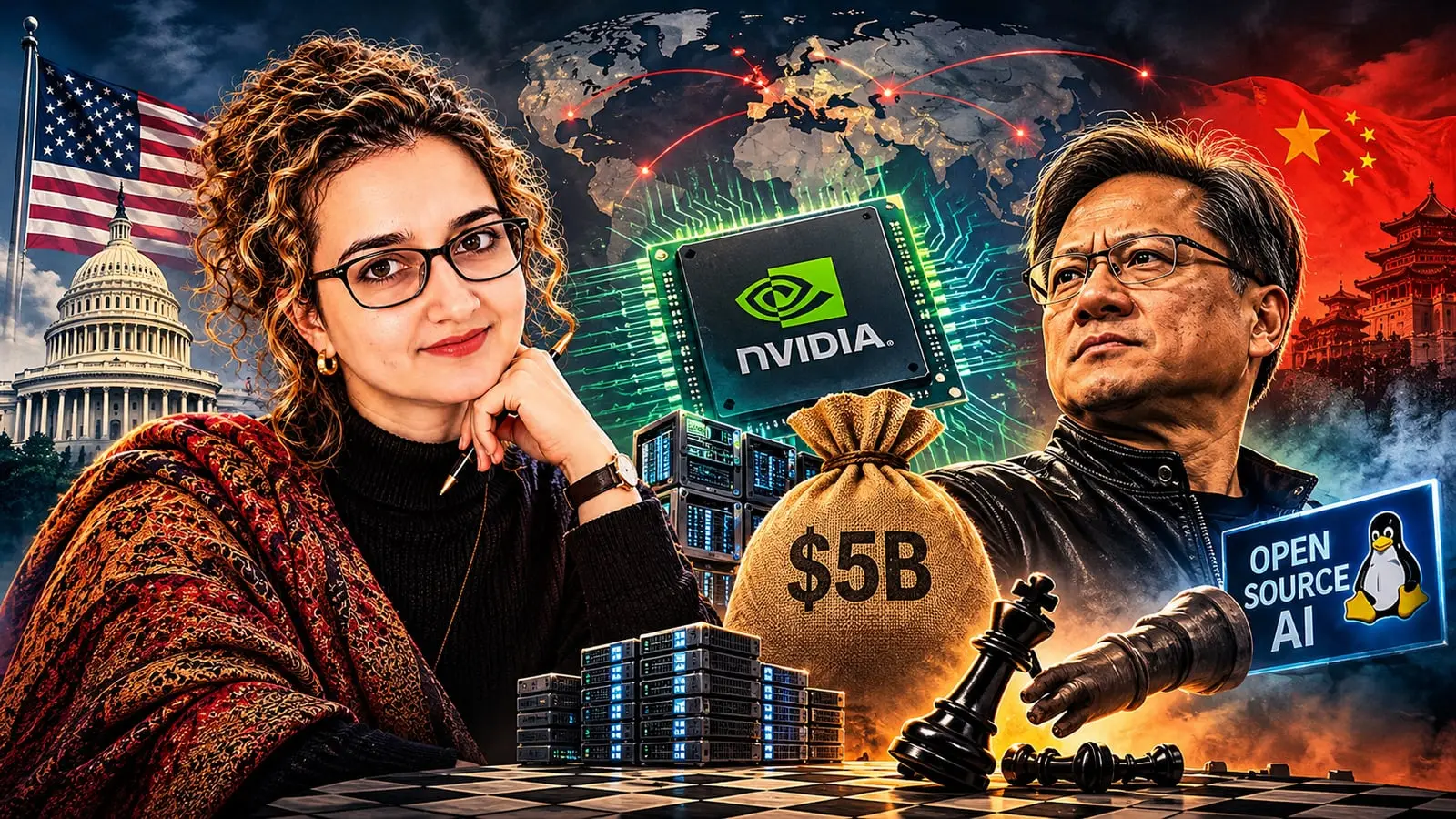
When Jensen Huang resigned as chief executive, president and board member of Nvidia on 12 November 2026, he ended a 33-year run at the company he co-founded. Most coverage packaged the fall as a tabloid morality play. The architect of the AI boom, the story went, had been undone by an affair with Alice Huang (also known as Huang Le), a Shanghai-born executive at Singapore-based Megaspeed International whom U.S. intelligence reportedly believed had been recruited by China's Ministry of State Security.
Buy that single-track narrative at your own risk. Reducing the Jensen Huang Nvidia scandal to a classic honeytrap is convenient for everyone in power and unhelpful to everyone else. Look at the chip trail, the policy record and the commercial interests around Nvidia, and a messier picture appears: a multi-sided collision in which almost nobody comes out clean.
On one side is a Chinese technology ecosystem that, according to multiple investigations, used corporate structures in Singapore and Malaysia to reach chips Washington had tried to deny it. On another is a CEO who, by his own admission, mixed a personal relationship with a company buying billions of dollars of his product. On a third is a Washington establishment that preached open markets for decades and now runs chip exports like a ration system. And on the fourth are the closed-model AI labs, which stand to gain from a weaker champion of open-source AI.
Update, 18 November 2026: no comeback, and a date with Congress
- The board says Huang is not coming back. On 17 November Huang said on X he would be "honored" to return if the board asked, and admitted he had "made serious mistakes in my personal life." Hours later Nvidia's board chair, Harvey Jones, said the board "does not intend to reinstate" him.
- He will face three House committees. Huang agreed to a transcribed, closed-door interview on 1 December with the Foreign Affairs, China Select and Intelligence committees; Nvidia's general counsel, Tim Teter, follows on 2 December. Nvidia denies violating any national-security law, and an interview is not a finding of wrongdoing.
- The business held up. Under interim chief executive Colette Kress, Nvidia reported third-quarter revenue of $115.8 billion, ahead of estimates of about $109 billion.
- Still unresolved: the "national champions" list has been reported but not published; the Megaspeed inquiries in the U.S. and Singapore continue, with no charges; and the board's own investigation is ongoing.
Timeline: how the Jensen Huang scandal unfolded
- October 2025: Senator Tom Cotton asks Commerce to investigate Megaspeed.
- 29 October 2026: the New York Times reports that U.S. intelligence believed Alice Huang was recruited to get close to Jensen Huang.
- 9 November: the Kistenmacher v. NVIDIA securities class action is filed.
- 12 November: Huang resigns as chief executive, president and board member; Colette Kress becomes interim CEO.
- 16 November: Commerce issues a rule requiring licences for advanced AI chips sent to data centres in Southeast Asia and Brazil.
- 17 November: the board says it does not intend to reinstate Huang; his House interview is set for 1 December.
In brief
Key takeaways
- What is established: Huang resigned on 12 November 2026 after acknowledging an extramarital affair. Nvidia's board said it had no reason to believe company secrets or national security were compromised. A securities class action, Kistenmacher v. NVIDIA Corporation, was filed on 9 November.
- What is alleged, not proven: that Alice Huang was a Chinese intelligence asset, and that Megaspeed diverted restricted Nvidia chips to China. Beijing denies the first; Megaspeed denies the second; no court or regulator has ruled on either.
- The money is large. Reports put Nvidia hardware moving through Megaspeed's network at between about $4.8 billion and $7.5 billion.
- Washington knew about Megaspeed for a year. Senator Tom Cotton asked the Commerce Department to investigate it in October 2025. The rule closing the Southeast Asian data-centre route came only in November 2026.
- Open-source AI lost its richest backer. Under Huang, Nvidia committed about $26 billion over five years to open-weight models, while its share of new frontier-lab compute deals fell to about 39%.
1. The shadow pipeline: Beijing's shell game and Huang's hubris
To dismiss the counterintelligence angle entirely is to ignore a substantial paper trail. Beijing has long used corporate front structures and personal relationships to reach restricted dual-use technology, and the timeline around Megaspeed reads, at the very least, like a case study in how export controls get tested.
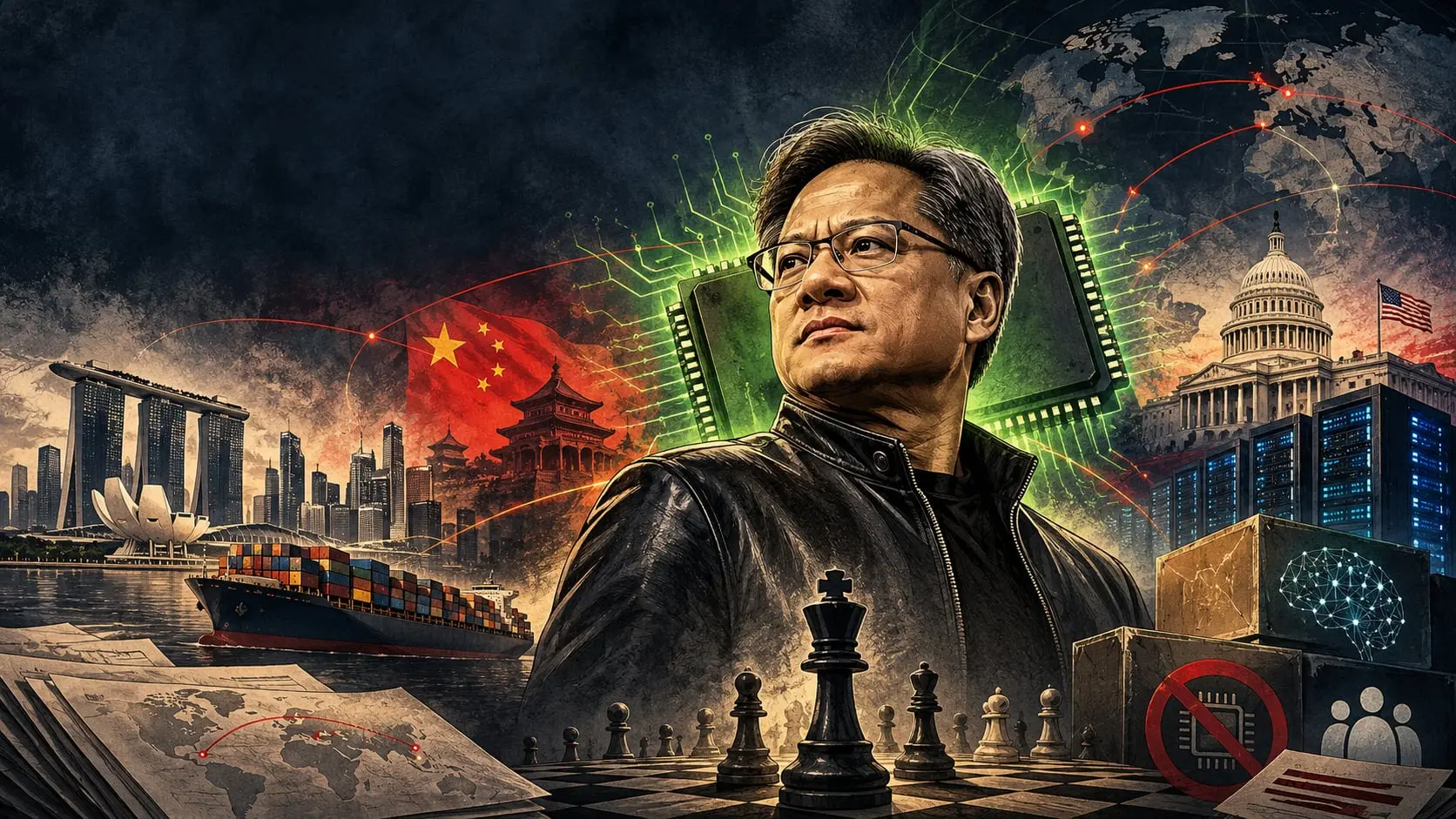
- The rebrand. Megaspeed began life as the Singapore arm of the Chinese gaming company 7Road and was relaunched under its current name in 2023, months after Washington's October 2022 controls on advanced AI chip sales to China.
- The fast-track. After a November 2023 sale to a Singapore company owned by its current chief executive, Megaspeed became an official Nvidia Cloud Partner just four days later, giving it priority access to scarce, high-end GPUs.
- The money trail. Reporting has put the Nvidia hardware moving through Megaspeed's network at about $4.8 billion; The Information alleged at least $7.5 billion. The Financial Times reported that Alibaba's Singapore subsidiary lent money in June 2024 to Speedmatrix, Megaspeed's Malaysian unit, which pledged its entire business as collateral, and that Alibaba was the anchor and largest customer of its Southeast Asian cloud service.
- The denials. Megaspeed denies illegally transferring chips to China and says inspections by U.S. and Malaysian authorities and by Nvidia found no violations. Malaysia's trade minister said on 10 November that no investigation had been opened into Speedmatrix. Nvidia says it found no evidence of diversion and that it had already blocked sales to Megaspeed in June 2025. Singapore's police have confirmed an investigation into "suspected breaches of our domestic laws". The U.S. Commerce Department's inquiry has been passed to the Justice Department.
If Beijing laid a trap, the question for Nvidia's shareholders is whether Huang walked into it with his eyes open. When the New York Times reported on 29 October that U.S. intelligence believed Alice Huang had been recruited to get close to him, Huang described the company's dealings with Megaspeed as "normal and not unusual". He later acknowledged an affair in a message to employees. Megaspeed says Alice Huang left the company on 30 August 2025.
That gap between public reassurance and private entanglement is the heart of the lawsuit. Kistenmacher v. NVIDIA Corporation (N.D. Cal., filed 9 November 2026) alleges that Nvidia and Huang misled investors by withholding information about his ties to a suspected spy, including a 2025 compliance statement about Megaspeed. These are allegations; no class has been certified and nothing has been proven in court. But they turned a private affair into a corporate-governance crisis, and no chief executive of a $4 trillion company should have needed to be told that a relationship with an executive at a multi-billion-dollar customer is a disclosure matter.
It is worth being precise about what is not established. CNN reported the same day as the Times story that U.S. officials disagreed about how strong the intelligence was. President Trump said, "I don't know that she is a spy." Beijing denies she is one, and Singapore's government has denied it is investigating her for espionage. No public evidence shows that Jensen Huang knowingly helped Chinese intelligence or that Alice Huang shaped Nvidia's business decisions.
2. The LPG hypocrisy: Washington's free-market double standard
The moralising from Washington lawmakers and defence hawks deserves just as much scrutiny. For four decades, the United States pressed the developing world to adopt LPG (liberalisation, privatisation and globalisation), insisting that private companies should be free to sell commercial goods across borders without state interference.
Nvidia is a publicly traded private enterprise, not a Pentagon munitions factory. Under the free-market capitalism Washington evangelises, a chief executive's duty is to shareholders, and an executive's private life is a matter for the company's board. Yet the moment China began to win at technological globalisation, Washington swapped the LPG rulebook for techno-nationalism, and chips became instruments of statecraft rather than products.
The record on Megaspeed sharpens the point. Senator Cotton wrote to Commerce Secretary Howard Lutnick in October 2025 asking him to investigate the company's ownership and its ability to skirt export laws. For more than a year, the route by which Chinese companies could rent advanced chips in Southeast Asian data centres stayed open, while U.S. firms booked billions of dollars in revenue from the region and Wall Street cheered. Only on 16 November 2026, four days after Huang's resignation, did Commerce issue an interim final rule requiring licences for advanced AI chip exports to data centres in Indonesia, Malaysia, Singapore, Thailand and Brazil.
In other words, the "Singapore washing" grey zone was tolerated while it was profitable, and closed once it produced a political scalp. To be fair to the facts, it was Nvidia's board, not the government, that forced Huang out; and Trump said he was open to Huang's return, though the board has since ruled it out. But the climate that made his position untenable was manufactured in Washington.
The market's verdict was brutal. By 10 November, Nvidia had lost about $1.7 trillion, roughly 30%, from its 6 October record. On the day of the resignation the shares fell as much as 14% intraday, erasing up to $601 billion in value, before closing about 4% lower; the next day the company closed below $4 trillion in market value for the first time since July 2025. An open letter, "Stand With Jensen", asking the board to reinstate Huang while an independent investigation establishes the facts, passed 160,000 signatures within days. Elon Musk, Travis Kalanick, Tim Sweeney and Garry Tan were among the signers. The message was blunt: Washington preaches free enterprise right up until a private chief executive becomes politically inconvenient.
- Huang's run as Nvidia's chief executive, 1993–2026
- 33 years
- CNBC
- fall in Nvidia's share price from its 6 October record to 10 November
- ~30%
- The Motley Fool
- reported value of Nvidia hardware moved through Megaspeed's network
- $4.8–7.5bn
- Fortune; The Information
- signatures on the open letter asking the board to reinstate Huang
- 160,000+
- Decrypt; The Hill
3. The Silicon Valley angle: who gains when open-source AI loses its champion
The least reported dimension of the Nvidia CEO controversy lies not in Beijing or Washington but in Silicon Valley. Whatever his personal failings, Jensen Huang had become the most powerful commercial backer of open-weight AI, and that put him at odds with the business model of the closed frontier labs, OpenAI and Anthropic among them.
Those labs have argued for compute thresholds, licensing and tight export walls in the name of AI safety and national security. Critics, including many open-source developers, say such rules also raise the cost of entry for smaller startups and for open-weight challengers such as China's DeepSeek and Qwen. Huang, meanwhile, was funding the other side of that argument:
- Bankrolling open models. Nvidia's filings, reported by Wired in March 2026, show it plans to spend about $26 billion over five years building open-weight models. Its Nemotron family, including Nemotron 3 Super, is published with weights, training data and recipes.
- A commercial logic, not charity. If frontier AI lives inside the closed APIs of a few giant labs, those labs can dictate prices and design their own chips to replace Nvidia's. That is already happening: a J.P. Morgan analysis by Michael Cembalest, published on 14 November 2026, found Nvidia's share of future frontier-lab compute agreements had fallen to about 39%, from more than 80% in 2023–25. Flooding the world with free, capable open models keeps millions of developers, companies and governments running on Nvidia hardware.
Custom chips designed with or by the labs now outweigh Nvidia GPUs in new deals. Open models are Nvidia's way of keeping everyone else on its hardware.
Source: J.P. Morgan (Michael Cembalest), via Seoul Economic Daily, 16 November 2026
View the data
| Nvidia GPUs | 39% |
|---|---|
| Broadcom custom chips | 24% |
| Google TPUs | 16% |
| AMD | 15% |
| Amazon Trainium | 6% |
Huang's removal takes open-source AI's richest corporate defender off the board. His interim replacement is Colette Kress, Nvidia's chief financial officer, a respected operator with no public record as a combatant in the AI-regulation fight. And within days, the Wall Street Journal reported that the administration plans to designate more than two dozen American firms, including Microsoft, Amazon, OpenAI and Anthropic, as AI "national champions" with fast-tracked export licences, federal financing and diplomatic support abroad.
Two cautions belong here. First, Nvidia is on that list too, so the programme is not simply a reward for the closed labs. Second, there is no public evidence that OpenAI, Anthropic or any other AI company played any part in Huang's departure. The argument of this piece is about incentives, not conspiracy: a world of state-anointed champions and licensed exports favours whoever is already big, and the voice that argued loudest for an open alternative is now outside the room.
4. Who won and who spun? The ledger
| Power centre | The official story | The less flattering reading |
|---|---|---|
| Beijing and Megaspeed | A Singaporean cloud company buying commercial GPUs to host AI in the region. | A rebranded Chinese gaming subsidiary that moved billions of dollars of advanced chips through Singapore and Malaysia, with Alibaba as lender and anchor customer. Alleged diversion to China is under investigation and denied. |
| Jensen Huang and Nvidia | Routine dealings with a major cloud partner, and a private lapse. | An undisclosed relationship with an executive at a large, politically sensitive customer, and public reassurances that a pending lawsuit says misled investors. |
| The U.S. government | Neutral enforcement of export controls in the name of national security. | A year of tolerating the Southeast Asian loophole, then closing it once it had produced a scandal, while steering exports through a hand-picked list of national champions. |
| OpenAI, Anthropic and the closed labs | Advocates of responsible AI, safety and American competitiveness. | Beneficiaries of rules and programmes that raise the cost of open-weight competition. There is no evidence they had any role in Huang's fall. |
5. The verdict: a scandal that suited almost everyone
The tragedy of the Jensen Huang Nvidia scandal is not that a billionaire lost his job. It is that nearly every power centre involved got something it wanted. China's tech companies reportedly obtained billions of dollars of frontier compute before the door closed. Washington's hawks got a scalp to justify turning global chip commerce into a state-supervised system. And the proprietary AI giants watched the most powerful commercial champion of open-source AI leave the stage, through no action of theirs that anyone has shown.
What remains genuinely open matters as much as what is known. The intelligence about Alice Huang has not been made public, Megaspeed's alleged diversions have not been proven, the shareholder suit is at its earliest stage, and Nvidia's board has not finished its own review. Huang has said he would return if asked; the board says it does not intend to reinstate him.
Whether you read his downfall as an espionage operation, a regulatory ambush or a gift to the closed-AI camp, one thing is clear: the era in which a single, privately run company could push the world toward open, cheaply available AI just became a lot harder to sustain. The people who benefit most are the ones best placed to decide who gets through the door next.
For the longer arc of how Huang built Nvidia in the first place, read our profile, Jensen Huang: The Thirty-Year Overnight Success.
Questions readers ask
Frequently asked questions
Why did Jensen Huang resign as Nvidia CEO? Huang resigned as chief executive, president and board member on 12 November 2026, after acknowledging an extramarital affair with Alice Huang, an executive at Megaspeed International, which U.S. intelligence reportedly suspected of being linked to China's Ministry of State Security. Nvidia's board said it had no reason to believe company secrets or national security were compromised.
Who is Alice Huang? Alice Huang, also known as Huang Le, is a Chinese businesswoman who worked as an executive at Singapore-based Megaspeed International until 30 August 2025, according to the company. The New York Times reported that U.S. intelligence believed she had been recruited to get close to Jensen Huang. Beijing denies she is a spy, and U.S. officials reportedly disagree on the strength of the evidence.
What is Megaspeed? Megaspeed International is a Singapore-based cloud and data-centre company that began as the Singapore arm of Chinese gaming firm 7Road and became an Nvidia Cloud Partner in 2023. It is under investigation over alleged diversion of restricted Nvidia chips to China, which it denies.
Who is Nvidia's CEO now? Colette Kress, Nvidia's chief financial officer, is interim chief executive. On 17 November board chair Harvey Jones said the board does not intend to reinstate Jensen Huang.
Will Jensen Huang testify to Congress? Yes. Huang agreed to a closed-door, transcribed interview on 1 December 2026 with the House Foreign Affairs, China Select and Intelligence committees, which are examining whether Nvidia chip sales to China endangered U.S. national security. Nvidia's general counsel, Tim Teter, appears on 2 December. Nvidia denies breaking national-security laws.
What is the Kistenmacher v. NVIDIA lawsuit? A proposed securities class action filed on 9 November 2026 in the U.S. District Court for the Northern District of California. It alleges Nvidia and Huang misled investors about his ties to a suspected spy. The class period runs from 9 October 2025 to 8 November 2026, and the lead-plaintiff deadline is 8 January 2027.
What does the scandal mean for open-source AI? Under Huang, Nvidia committed about $26 billion over five years to open-weight models such as Nemotron. His departure removes the most powerful corporate advocate for open models at a moment when U.S. export policy is concentrating on a list of designated national champions.
Sources
Sources
- CNBC: Nvidia CEO Jensen Huang resigns, live updates (12 November 2026)
- CNBC: What is Megaspeed? The Nvidia chip buyer in the spotlight (9 November 2026)
- Bloomberg: Nvidia's Huang defends Megaspeed ties as US probes China spying allegations (29 October 2026)
- CBS News: Nvidia investigates CEO Jensen Huang amid allegations he was target of Chinese intelligence effort
- U.S. News: What we know about Chinese businesswoman Alice Huang (13 November 2026)
- Newsweek: Trump open to Nvidia's Huang return, doubts China "spy"
- Fortune: How Megaspeed built a network in Singapore and Malaysia to move $7.5 billion of Nvidia chips (11 November 2026)
- The Star: Nvidia scandal's Malaysian link (10 November 2026)
- Senator Tom Cotton: letter to Commerce Secretary Lutnick on Megaspeed (October 2025)
- Fortune: New Commerce rule targets Singapore and Malaysia chip route (16 November 2026)
- Kistenmacher v. NVIDIA Corporation, complaint (N.D. Cal., 5:26-cv-13448)
- The Motley Fool: Nvidia stock has wiped out $1.7 trillion in value since October (10 November 2026)
- CNBC: Nvidia closes below $4 trillion market cap for first time since July 2025 (13 November 2026)
- Decrypt: Elon Musk joins 160,000 backing petition to bring Jensen Huang back
- The Hill: Elon Musk joins leaders demanding Jensen Huang's return to Nvidia
- Implicator: Nvidia commits $26 billion to open-weight AI, ships Nemotron 3 Super
- Seoul Economic Daily: Nvidia's share of AI compute falls to 39% (16 November 2026)
- Quartz: Trump administration to name Nvidia among AI "national champions"
- NBC News, "Jensen Huang agrees to House interview" (17 November 2026)
- NPR, "Nvidia board says it does not intend to reinstate Huang" (17 November 2026)
Editor's note: This is an opinion piece; views are the author's own. Labelled facts are drawn from the sources above. The espionage allegations against Alice Huang, the alleged chip diversions by Megaspeed and the claims in Kistenmacher v. NVIDIA are unproven, and all parties named deny wrongdoing or have not been found liable.