
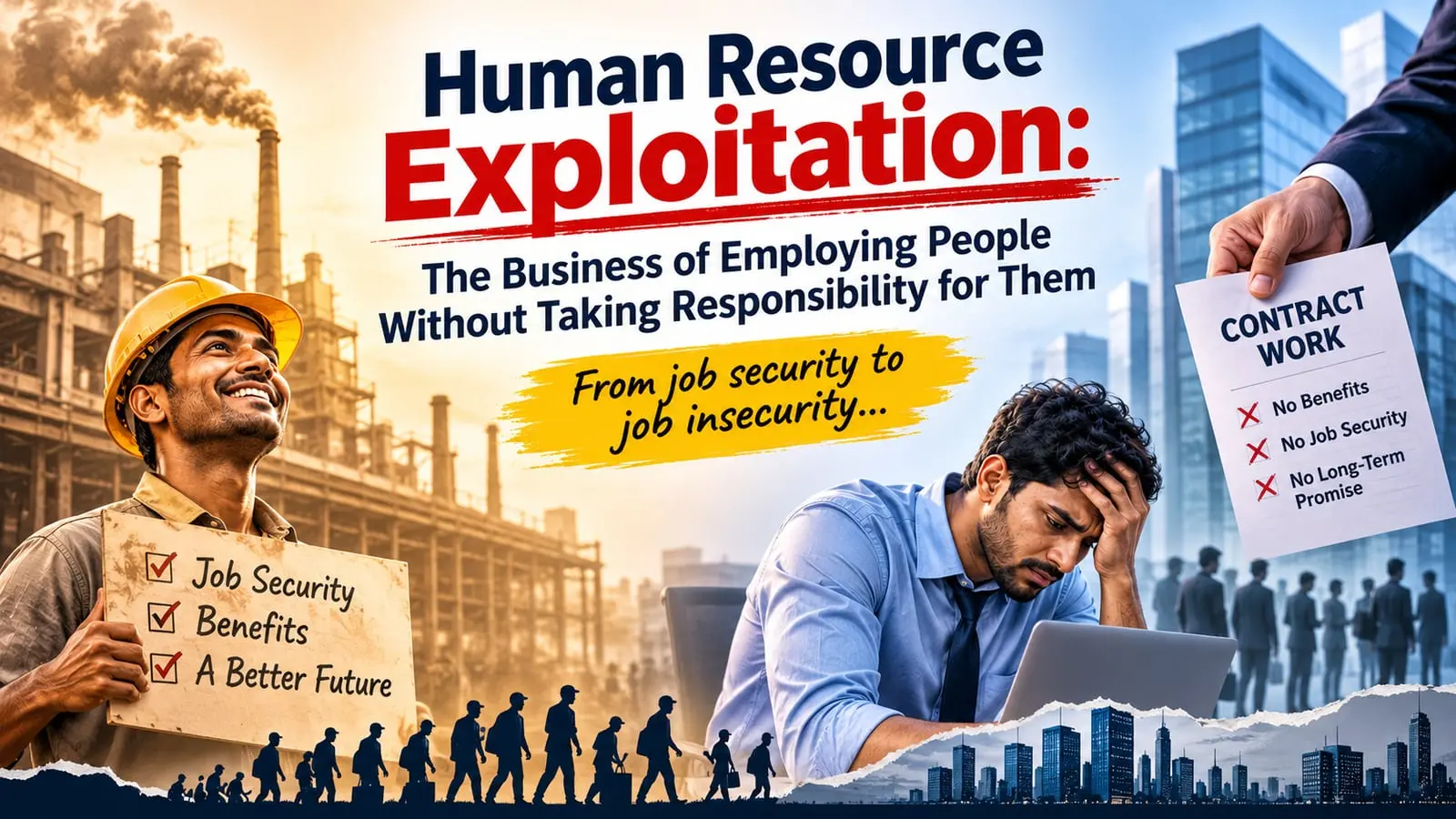
There was a time when industrialisation promised people something that working independently often could not: stability.
As industries expanded, people were encouraged to move away from small, independent occupations and traditional ways of earning a livelihood to become part of organised industrial workforces. In return, employment gradually came to represent more than a monthly salary. It meant a relatively predictable income, job security, paid leave, retirement benefits, healthcare and a sense of belonging to an organisation.
The employer-employee relationship was built around an understanding: you contribute your skills, time and productivity, and the organisation provides compensation, protection and a degree of stability.
But somewhere along the way, that understanding began to change.
Today, we seem to be moving towards an economic model where organisations want the productivity of permanent employees without necessarily accepting the responsibilities associated with employing them.
We want employees to work like permanent employees, deliver like permanent employees, remain available like permanent employees, but increasingly live with the insecurity of temporary workers.
Welcome to the changing economics of human resources.
This essay is about that gap: between the work people do and the protection they receive for doing it. It looks at contract workers, gig and platform workers, fixed-term staff and the growing use of outsourcing, including by governments themselves. It also looks at what India's new Labour Codes actually say, and what employers and workers can do about it today.
In brief
Key takeaways
- Contract work, freelancing and gig work are not exploitative by design. The problem begins when "flexibility" is used to move almost every business risk onto the worker while the employer keeps full control of the work.
- Roughly two in five workers in India's organised manufacturing sector were contract workers in 2022–23, according to the Annual Survey of Industries, up from 38% in 2018–19.
- NITI Aayog estimated 7.7 million gig workers in 2020–21 and projected 23.5 million by 2029–30. The Code on Social Security, 2020 now recognises gig and platform workers, and aggregators must contribute 1–2% of annual turnover, capped at 5% of what they pay these workers.
- The four Labour Codes took effect on 21 November 2025, replacing 29 central labour laws. They introduce mandatory appointment letters, a statutory minimum wage for all workers, and gratuity for fixed-term employees after one year instead of five.
- A contractual label does not cancel statutory duties. Minimum wages, timely payment and applicable social-security contributions still apply, and principal employers carry responsibility for contract workers placed in their premises.

1. From employment security to employment flexibility
Contractual employment, freelancing and gig work are not new concepts. Nor are they inherently exploitative.
They provide opportunities for people who prefer flexibility, independent work or project-based engagements. They allow businesses to scale operations according to demand. For many people, flexibility is a genuine benefit.
The problem begins when flexibility becomes an excuse to transfer almost every business risk to the worker.
Consider the changing employment landscape.
A company once hired an employee, invested in training, provided benefits and accepted responsibility for maintaining a workforce. Today, the same organisation may choose to engage people through third-party contractors, staffing agencies or short-term contracts.
The work may remain identical. The reporting manager may remain identical. The deadlines, working hours, performance expectations and organisational control may remain identical.
But the employment relationship changes.
The organisation gets the work done, while the worker may lose access to several benefits and protections associated with regular employment.
This is not a hypothetical trend. India's Annual Survey of Industries, which covers the organised factory sector, tracks the ratio of contract workers to total workers. According to the ASI results for 2022–23, released by the Ministry of Statistics and Programme Implementation in September 2024, that ratio rose from 0.38 in 2018–19 to 0.41 in 2022–23, edging up in each of the last three years. Put simply, about two of every five workers on the factory floor in the formal sector are now engaged through contractors rather than directly.
Source: MoSPI, ASI 2022–23 results (PIB, 30 September 2024). Ratio of contract workers to total workers.
View the data
| 2018–19 | 38% |
|---|---|
| 2019–20 | 38% |
| 2020–21 | 39% |
| 2021–22 | 40% |
| 2022–23 | 41% |
Why?
Because employment is no longer viewed only as a long-term investment in human capital. Increasingly, it is also treated as a cost that needs to be optimised.
2. The economics of avoiding employment responsibilities
Let's look at this from a business perspective.
When an organisation employs someone directly, its financial responsibilities can extend beyond the employee's monthly salary.
Depending on eligibility and applicable laws, these may include:
- Employer contributions towards provident fund.
- Employee State Insurance contributions.
- Gratuity.
- Statutory bonus.
- Paid leave and other applicable benefits.
- Notice-period and retrenchment-related obligations.
- Training, onboarding and employee development costs.
Now consider an organisation engaging workers through a third-party staffing company.
The organisation pays the contractor or staffing agency, and the contractual arrangement changes how employment administration and certain responsibilities are handled. The contractor becomes the employer on paper. The contractor issues the appointment letter, runs payroll and, in principle, deposits the statutory contributions.
This can make workforce costs more flexible and predictable.
There is nothing inherently wrong with this arrangement. Genuine outsourcing can improve efficiency, especially for temporary, specialised or non-core requirements. Housekeeping, security, canteen services and specialised maintenance are classic examples of work that many organisations reasonably hand to specialist firms.
But here is the uncomfortable question:
Are organisations outsourcing work because they need specialised flexibility, or are they outsourcing employment relationships because they want to avoid the responsibilities that come with employing people?
The distinction matters.
In an earlier essay, The Startup Delusion, I wrote about founders who over-hire when money is easy, inflate titles, and then neglect their obligations to staff and vendors when money tightens. The same pattern appears at a larger scale here. When cost pressure arrives, the people with the weakest contracts absorb the shock first, regardless of how central their work was to the business.
A contract should define the nature of the engagement, not become a convenient instrument to disguise an employment relationship.
A worker should not have to sacrifice basic dignity and statutory protection simply because their appointment letter comes from a contractor rather than the organisation whose business they serve.
3. The gig economy: opportunity or a new form of insecurity?
The numbers tell us that this transformation is not marginal.
According to NITI Aayog's report India's Booming Gig and Platform Economy, released in June 2022, India had an estimated 7.7 million gig workers in 2020–21. They made up 2.6% of the non-agricultural workforce, or 1.5% of the total workforce.
The report projected that this number could reach 23.5 million by 2029–30.
That is about three times the 2020–21 estimate.
ProjectionSource: NITI Aayog, India's Booming Gig and Platform Economy (June 2022)
View the data
| 2020–21 | 7.7M |
|---|---|
| 2029–30 (projected) | 23.5M |
The report also projected that gig workers could account for 6.7% of India's non-agricultural workforce, or 4.1% of total livelihoods, by 2029–30. It found that about 47% of gig work was in medium-skilled jobs, about 22% in high-skilled jobs and about 31% in low-skilled jobs.
Source: NITI Aayog (June 2022)
View the data
| Medium-skilled | 47% |
|---|---|
| Low-skilled | 31% |
| High-skilled | 22% |
Source: NITI Aayog.
This expansion represents a significant economic opportunity. It creates new earning possibilities and allows people to access work through digital platforms.
However, it also raises serious questions.
Who provides income security when work suddenly disappears?
Who takes responsibility when a worker is injured?
What happens when a platform changes its payment structure?
Who provides retirement security to someone who spends 15 or 20 years working without a conventional employer?
Where the policy response stands in late 2026
The policy response is real, but it is still early.
- Central law. The Code on Social Security, 2020 defines "gig worker", "platform worker" and "aggregator". Under the codes made effective in November 2025, aggregators must contribute 1–2% of their annual turnover towards social security for these workers, capped at 5% of the amount paid or payable to gig and platform workers.
- Central rules. The Social Security (Central) Rules, 2026 were notified on 8 May 2026. To be eligible for benefits under schemes for gig and platform workers, a worker must have been engaged for at least 90 days with one aggregator, or 120 days across multiple aggregators, in the previous financial year.
- Registration. The e-Shram portal, launched on 26 August 2021 as a national database of unorganised workers, had recorded 31.89 crore registrations as of 18 August 2026. Of these, around 11.5 lakh were platform workers, according to the Ministry of Labour and Employment's five-year factsheet. Set that against NITI Aayog's estimate of 7.7 million gig workers five years earlier and the coverage gap is obvious.
- State laws. Rajasthan became the first state to pass a gig workers' welfare law in 2023. Bihar and Jharkhand passed similar laws in 2025, and Telangana passed its law in 2026. Karnataka's Platform-Based Gig Workers (Social Security and Welfare) Act, 2025 allows a welfare fee of 1–5% of worker payouts; the state notified a 1% fee with transaction-wise caps. Several platforms have challenged the Act in the Karnataka High Court. As of July 2026 the court had declined to stay the law and directed platforms to deposit the welfare fee, while the constitutional challenge remained pending.
A person can be called an independent partner, delivery associate, consultant or service provider. But changing the designation does not automatically change the economic reality of their dependence on that work.
The challenge is to ensure that the growth of the gig economy does not create a permanently insecure workforce.
4. When even governments become part of the problem
Perhaps the most uncomfortable part of this discussion is the role of governments.
Governments are expected to establish labour standards, protect vulnerable workers and ensure that businesses follow the law.
Yet government departments themselves frequently rely on contractual, outsourced, temporary and ad hoc appointments to fulfil operational requirements. In a written reply in the Lok Sabha in July 2023, the Ministry of Labour and Employment itself acknowledged that while government posts are filled according to recruitment rules, "outsourcing for services through contract is also sometimes resorted to" because of administrative exigency.
There can be legitimate administrative reasons for such appointments. Not every position needs to be permanent.
But the problem emerges when contractual arrangements become a substitute for regular staffing, particularly for work that is continuous and essential.
Imagine a government department requiring someone to perform a full-time role, follow departmental instructions and deliver work every working day, but engaging that person through an arrangement that offers significantly less security.
The courts have noticed. In Jaggo v. Union of India, decided in December 2024, the Supreme Court observed that engaging workers on a temporary basis for extended periods "mirrors the detrimental trends observed in the gig economy", and that government departments "bear an even greater responsibility to avoid such exploitative employment practices". The Court also said that the principles of its 2006 Constitution Bench judgment in Secretary, State of Karnataka v. Umadevi are "often misinterpreted or misapplied to deny legitimate claims" of long-serving temporary staff. Umadevi had held that irregular or temporary appointees have no automatic right to regularisation, while allowing a one-time regularisation of those who had served ten years or more against sanctioned posts.
On pay, the Court was clear even earlier. In State of Punjab v. Jagjit Singh (26 October 2016), it held that the principle of "equal pay for equal work" is vested in every employee, "whether engaged on regular or temporary basis". Temporary employees doing the same work as regular staff in the same post were entitled to wages at least at the minimum of the regular pay scale.
The question is not whether every contractual government worker should automatically receive the same package as a permanent government employee.
The question is whether the government is honouring the minimum standards it expects private employers to follow.
There is an important legal distinction here.
The Government of India has told Parliament that statutory and contractual obligations towards outsourced employees engaged to provide services to the government are governed by the applicable labour laws, including the laws on minimum wages, payment of wages, bonus and gratuity. Minimum wages are fixed by the appropriate government, Central or State, depending on the employment. In plain terms, a person working in a government office through an outsourcing agency is entitled to at least the notified minimum wage.
In addition, the Code on Wages, 2019, now in force, establishes minimum-wage protection across employments, subject to the applicable statutory framework. Before the codes, minimum wages applied only to "scheduled" employments, which left large groups of workers uncovered.
There is some movement on enforcement. On 8 May 2026, the Department of Expenditure issued an Office Memorandum to all ministries and departments on the timely payment of wages to manpower engaged directly or through contractors. It requires drawing and disbursing officers to verify every month that contractors have paid wages on time, asks for penalty clauses in manpower contracts, and directs principal employers to pay contract workers directly if payment is delayed inordinately. Contractors who fail to pay can be blacklisted, and for a repeat offence, blacklisted across all ministries and departments under the General Financial Rules.
That is welcome. It is also an admission that the problem was common enough to need an instruction.
If the government sets a minimum standard, it must be accountable for ensuring that its own departments and contractors respect it.
A government cannot credibly advocate worker welfare while treating the people delivering its own public services as an expendable resource.
5. What does the law actually say?
India has not been without labour protections. In fact, the legal framework has undergone a significant transformation.
The four Labour Codes were brought into effect on 21 November 2025, consolidating 29 central labour laws. Many of those laws dated from the 1930s to the 1950s. The central rules under the codes followed in May 2026.
Some important provisions deserve attention:
The Code on Wages, 2019
- Establishes minimum-wage protection across employments.
- Provides for a statutory floor wage.
- Prohibits gender-based discrimination in wages and recruitment for the same or similar work.
- Provides for timely payment of wages and regulates deductions.
The Code on Social Security, 2020
- Recognises gig workers and platform workers in the statutory framework.
- Provides for social-security schemes covering areas such as life and disability protection, accident insurance, health and maternity benefits and old-age protection.
- Establishes a framework for financing social-security schemes, including through aggregator contributions where applicable.
- Makes fixed-term employees eligible for gratuity after one year of continuous service, instead of five.
Source: Ministry of Labour and Employment (PIB, 21 November 2025)
View the data
| Permanent employee | 5 yr |
|---|---|
| Fixed-term employee | 1 yr |
The Industrial Relations Code, 2020
- Regulates industrial relations, including provisions concerning trade unions, standing orders, layoffs, retrenchment and closure.
- Provides a framework for fixed-term employment and related benefits. According to the government, fixed-term employees are to receive benefits on par with permanent workers doing the same work, including wages, leave, medical and social-security benefits.
The Occupational Safety, Health and Working Conditions Code, 2020
- Addresses workplace health, safety and working conditions.
- Includes provisions relating to contract labour and working conditions. It replaced the Contract Labour (Regulation and Abolition) Act, 1970. Its contract-labour chapter applies where 50 or more contract workers are deployed, compared with a threshold of 20 under the 1970 Act in most states.
- Generally restricts the use of contract labour in "core activities", meaning the work an establishment is set up to do, with exceptions such as work normally done through contractors, work that does not need full-time workers, or a sudden surge in work.
- Makes the principal employer responsible for ensuring that the contractor pays wages on time.
The government has also announced mandatory appointment letters for all workers and free annual health check-ups for workers above 40.
There is an important distinction: contractual and gig workers are not automatically entitled to every benefit available to regular employees. Their rights depend on their legal classification, applicable provisions and eligibility.
But neither does a contractual designation mean that an employer can simply ignore minimum wages or applicable statutory obligations.
The existence of laws is important. Their implementation and enforcement are equally important.
Sources: Ministry of Labour and Employment, Government of India; India Code.
Contract vs fixed-term vs gig vs permanent: what each worker is entitled to
The table below is a simplified guide. Actual entitlements depend on eligibility, wage ceilings, establishment size and the applicable central and state rules.
| Permanent employee | Fixed-term employee | Contract worker (via contractor) | Gig / platform worker | |
|---|---|---|---|---|
| Who is the legal employer | The organisation | The organisation, for a fixed period | The contractor; the organisation is the "principal employer" | No conventional employer; works through an aggregator or platform |
| Minimum wage | Yes | Yes | Yes | Not covered by employee wage rules in the same way; depends on classification |
| Appointment letter | Mandatory under the codes | Mandatory under the codes | Mandatory under the codes (issued by the contractor) | Platform terms of engagement |
| PF and ESI | Yes, subject to eligibility and thresholds | Yes, subject to eligibility and thresholds | Yes, subject to eligibility and thresholds; the contractor deposits, the principal employer must ensure compliance | Not through PF/ESI by default; through schemes under the Social Security Code funded partly by aggregators |
| Gratuity | After five years of continuous service | After one year of continuous service | Depends on continuous service with the contractor | No |
| Paid leave | Yes | Yes, on par with permanent staff | Yes, as applicable | No |
| Retrenchment protection | Yes, under the Industrial Relations Code | Contract ends on expiry; no retrenchment compensation for non-renewal | Limited; usually tied to the contractor's contract | No |
| Social-security schemes | Employer-linked | Employer-linked | Employer-linked, via the contractor | Eligibility after 90 days with one aggregator or 120 days across several, plus e-Shram registration |
How to tell genuine outsourcing from a disguised employment relationship
Courts and labour authorities look at the substance of a relationship, not its label. These questions help separate a genuine service contract from a disguised employment relationship:
- Who controls the work? If the organisation's managers assign daily tasks, set hours, approve leave and appraise performance, the contractor is supplying people, not a service.
- Is the work core and continuous? Work that the organisation exists to do, and that continues year after year, is a warning sign when done through contract labour.
- Does the contractor bring anything besides people? A genuine service provider brings its own expertise, supervision, tools or systems. A pure head-count supplier does not.
- Do the same people stay for years? If workers stay on the same desk while the contractor's name changes every year or two, the arrangement deserves scrutiny.
- Is the contract priced as a service or as salaries plus a margin? Payment calculated per head, per month, looks like payroll rather than a service.
- Are statutory dues visible? If no one can show PF, ESI and wage-payment records for the contract workers, the arrangement is failing the most basic test.
- Do contract workers sit beside permanent staff doing identical work for less? That is precisely the situation the "equal pay for equal work" principle was meant to address.
No single factor is decisive. Together, they show whether an organisation is buying a service or renting a workforce.
This section is general information, not legal advice. For a specific situation, consult a labour-law professional or the labour department of your state.
6. The human cost of treating people as costs
There is another dimension that rarely appears in quarterly financial statements.
When an employee is laid off, the immediate impact is not restricted to that individual's income.
It affects a household.
It affects children's education, housing commitments, medical expenses, financial planning and the ability to support ageing parents. An EMI does not pause because a contract was not renewed. School fees do not wait for the next assignment.
When a company repeatedly hires and fires based on short-term financial targets, it creates an environment where employees struggle to build long-term security.
When an employee knows that a contract may not be renewed, they are less likely to challenge unreasonable expectations, report workplace problems or negotiate fairly.
Fear becomes an invisible management tool.
And this creates a contradiction.
Companies spend millions on employee engagement programmes, leadership development, culture-building exercises and employer branding. Yet some of their employment practices communicate the opposite message.
You cannot build trust through a corporate presentation while creating insecurity through everyday decisions.
An employee is not just a line item in an operating expense statement.
They are people with families, responsibilities, ambitions and financial commitments.
Businesses have every right to pursue efficiency and profitability. But efficiency should not be confused with extracting the maximum possible output from people at the minimum possible cost.
7. Who is questioning the balance?
The responsibility does not lie with companies alone.
Governments must enforce labour standards. Businesses must adopt responsible employment practices. Industry associations must encourage ethical workforce management. Employees must have accessible channels to raise concerns.
And society must stop treating every employment arrangement as a success simply because it creates a job.
A job that provides income but no reasonable protection, stability or dignity deserves scrutiny.
We should be asking better questions:
- Are contractual arrangements being used for genuine business flexibility or to avoid employment responsibilities?
- Are workers receiving the statutory benefits to which they are entitled?
- Are organisations investing in people or merely purchasing their availability?
- Are governments setting an example through their own employment practices?
- Are business leaders measuring success only through margins, or also through the quality of livelihoods they create?
The purpose of business is not merely to reduce costs. It is to create value.
And human beings are central to that value creation.
What responsible employers can do
Some practical commitments any organisation can make:
- Hire directly for core, continuous work. If a role has existed for three years and will exist for three more, it is not a temporary need.
- Use fixed-term contracts honestly. Fixed-term employment is now a direct relationship with parity in benefits. It should not be a rolling series of short contracts designed to sit just below eligibility thresholds.
- Audit your contractors, not just their invoices. Ask every staffing vendor for monthly proof of wage payment, PF and ESI challans for the workers deployed with you. Make this a contract condition, with penalties for default.
- Issue clear appointment letters. Make sure every worker on your premises, direct or contracted, knows their designation, wage and social-security entitlements in writing.
- Offer a path inward. Give long-serving contract workers a fair route to direct employment when roles open.
- Measure it. Track the share of contract workers in core roles, average tenure on contract and statutory compliance, and report them to the board alongside financial metrics.
What workers can check
If you work through a contractor, an agency or on a fixed-term contract, a few simple checks can tell you whether your employer is meeting its basic obligations:
- Your appointment letter. You should have a written letter stating your designation, wages and social-security entitlements.
- Your payslip. Check that gross wages, deductions and net pay are itemised, and that wages arrive on time.
- Your UAN and EPF passbook. If PF is being deducted from your salary, you should have a Universal Account Number. Check the EPFO member passbook regularly to confirm that both your share and the employer's share are actually being deposited.
- Your ESI registration. If you are covered by ESI, you should have an ESIC number and be able to use ESI medical facilities.
- e-Shram. If you are an unorganised, gig or platform worker and not a member of EPFO or ESIC, you can register free of cost on the e-Shram portal with your Aadhaar and a mobile number. It is the gateway to several central schemes, including accident and life insurance and a contributory pension scheme.
- Keep records. Save offer letters, payslips, attendance records and messages assigning work. Under the codes, workers can raise claims for pending dues up to three years later, and records make those claims credible.
If something is missing, raise it in writing with the contractor and the principal employer, and approach the labour department if it is not resolved.
8. A different approach to building businesses
At Fensso, we work in the technology and business solutions space, where efficiency, automation and scalability are central to how organisations operate. We serve clients in India and, through Fensso US, in the United States.
Through our work in software engineering, IT consulting and enterprise solutions, including our software-development company TechOvelpo, we see technology as an opportunity to make businesses more efficient.
But efficiency should not mean reducing people to disposable resources.
We believe businesses should use technology to remove unnecessary administrative burdens, improve processes, create transparency and help people perform better.
Whether it is HRMS, CRM, ERP, supply-chain management or procurement systems such as our procure-to-pay platform Krayuv, the objective should be to build organisations that function better, not simply organisations that squeeze more out of their workforce. The same systems that track invoices and purchase orders can track whether a vendor has paid its workers, deposited their dues and renewed their licences. Transparency is a design choice.
Technology should empower people, not make them easier to exploit.
And as we build Fensso, this is an important principle we want to stand by: business growth and human dignity should not be competing objectives.
A company can be ambitious, profitable, technology-driven and cost-conscious without losing sight of the people who make its success possible.
You can read more about my work and earlier writing on my HustleMemo profile.
Conclusion
The question we should leave ourselves with
Industrialisation once brought people into organised employment by promising a better and more secure future.
Today, as technology, automation and new employment models reshape the workplace, we need to ask whether we are progressing towards a better future or simply finding more sophisticated ways to transfer risk from organisations to individuals.
The future of work should not be measured only by how much businesses can automate, outsource or save.
It should also be measured by the quality of opportunities they create and the dignity they preserve.
Because ultimately, an organisation may replace an employee, outsource a department or automate a function.
But it cannot build a sustainable economy by treating its workforce as disposable.
People are not business expenses to be eliminated. They are the foundation on which businesses are built.
Questions readers ask
Frequently asked questions
Are contract workers entitled to PF and ESI in India?
Generally yes, if they meet the eligibility conditions and wage thresholds that apply to the establishment. The contractor is usually the employer responsible for deducting and depositing contributions, but the principal employer is expected to ensure compliance. Workers can confirm deposits through their EPFO passbook using their UAN.
What do the new labour codes mean for gig workers?
The Code on Social Security, 2020 recognises gig and platform workers for the first time and requires aggregators to contribute 1–2% of annual turnover, capped at 5% of payouts to these workers, towards social-security schemes. Under the Social Security (Central) Rules, 2026, eligibility for scheme benefits requires at least 90 days of work with one aggregator, or 120 days across several, in the previous financial year. Gig workers do not automatically become employees.
Is outsourcing employees legal in India?
Yes. Engaging workers through licensed contractors is legal. But the OSH Code generally restricts contract labour in an establishment's core activities, subject to exceptions, and the principal employer remains responsible for ensuring that contract workers are paid on time. Outsourcing becomes a problem when it is used to disguise what is in substance a direct employment relationship.
Can contract workers be paid less than the minimum wage?
No. Under the Code on Wages, 2019, the minimum wage applies to all employees, including those engaged through contractors and outsourcing agencies, and including those working in government offices.
Are fixed-term employees entitled to gratuity?
Under the labour codes, fixed-term employees become eligible for gratuity after one year of continuous service, instead of the five years required for permanent employees. Fixed-term employees are also meant to receive benefits on par with permanent workers doing the same work.
Do temporary employees have a right to equal pay for equal work?
In State of Punjab v. Jagjit Singh (2016), the Supreme Court held that temporary government employees performing the same duties as regular staff in the same post are entitled to wages at least at the minimum of the regular pay scale. Whether the principle applies in a particular case depends on the facts.
Sources
Sources
- NITI Aayog launches report on India's gig and platform economy (PIB, 27 June 2022)
- NITI Aayog: India's Booming Gig and Platform Economy, policy brief (June 2022)
- Government makes the four Labour Codes effective (PIB, 21 November 2025)
- 5 Years of e-Shram Portal factsheet (PIB, 25 August 2026)
- Protection of interests of employees through outsourcing agencies, Lok Sabha reply (PIB, 24 July 2023)
- Standard wage rate for migrant workers, Rajya Sabha reply (PIB, 8 February 2024)
- Department of Expenditure Office Memorandum on timely payment of wages to manpower engaged directly or through contractors (8 May 2026)
- Annual Survey of Industries results for 2022–23 (PIB / MoSPI, 30 September 2024)
- The Social Security (Central) Rules, 2026 (PRS Legislative Research)
- Karnataka Gig Workers Act: what the law says and why it's contested (Business Standard, 8 July 2026)
- Contract labour under the new regime: an overview (Lakshmikumaran & Sridharan)
- Supreme Court on State of Punjab v. Jagjit Singh, equal pay for equal work (SCC Online, 26 October 2016)
- Supreme Court in Jaggo v. Union of India on long-term temporary engagement and Umadevi (LiveLaw, December 2024)
- e-Shram portal (Ministry of Labour and Employment)
- India Code: central labour codes
Editor's note: This is a guest essay by Divyansh Dixit, founder of Fensso Tech LLP and TechOvelpo, in HustleMemo's Perspectives section. Views are the author's own. It describes general practices and does not refer to any specific company. This article is for information and is not legal advice.
More on Divyansh Dixit: his HustleMemo profile, the profile Divyansh Dixit: Building the Empire, From Ghaziabad to Bangalore, and his earlier essay The Startup Delusion: When Founders Build Empires Before Building Businesses.