

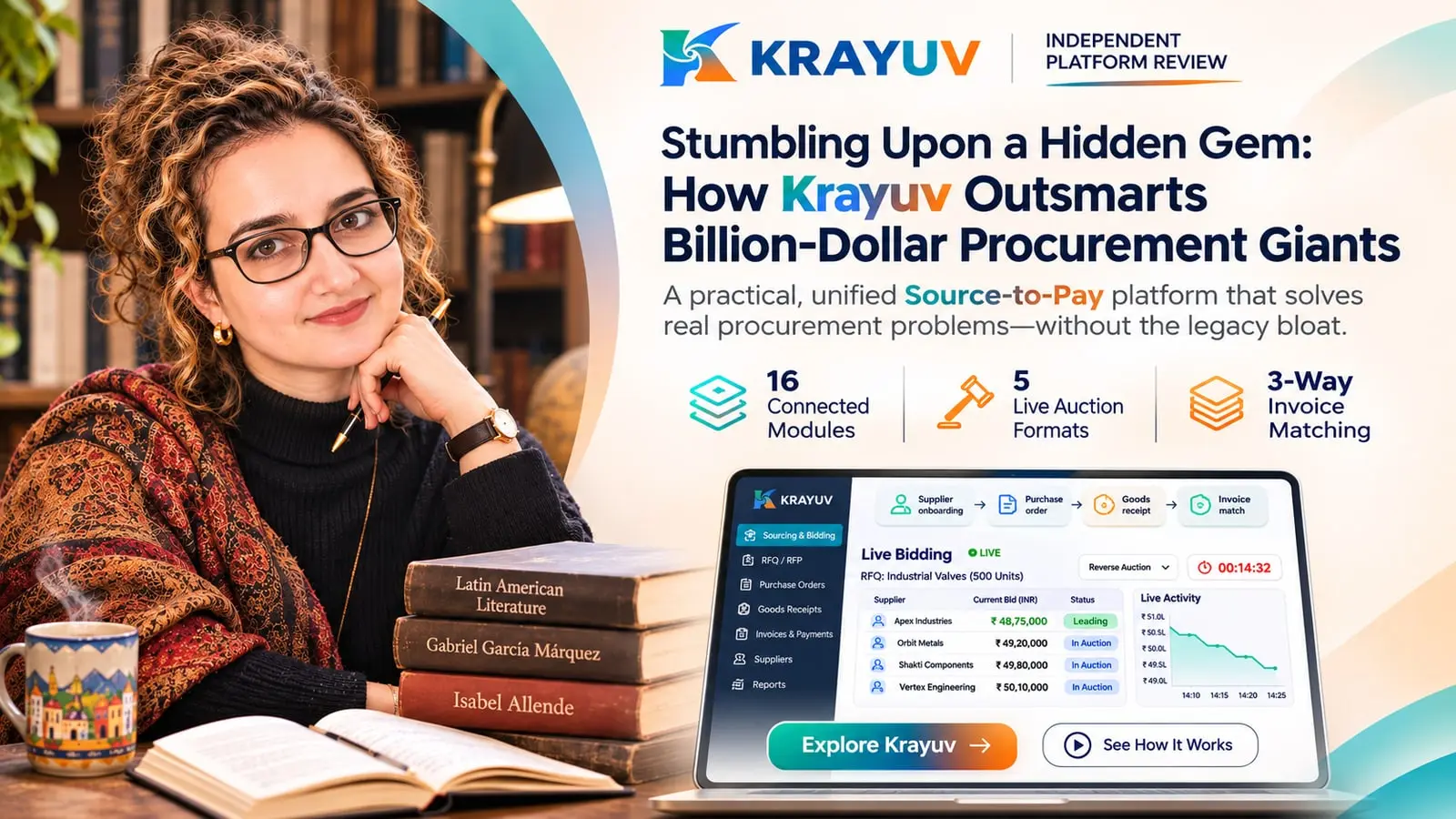
Krayuv is an Indian Source-to-Pay procurement platform that puts supplier onboarding, RFQs, five live auction formats, purchase orders and OCR 3-way invoice matching into one workspace. This Krayuv review covers what it gets right, how it compares with SAP Ariba, Coupa and point tools, and where it still needs to improve.
If you spend enough time covering enterprise software and talking to operations leaders, you develop a healthy skepticism toward B2B SaaS pitches. Every week, another billion-dollar procurement giant (think SAP Ariba, Coupa or Jaggaer) releases a press release touting "autonomous AI spend management", while the actual buyers and finance managers on the ground are still exporting CSV files at 7:00 PM to manually match invoices against delivery receipts.
That disconnect is why my recent discovery of Krayuv (krayuv.com) caught me off guard. I wasn't looking for a new procurement suite; I was researching how mid-market manufacturing and supply-chain teams handle multi-round supplier bidding without hiring a small army of consultants. Tucked away from the noise of billion-dollar marketing budgets, Krayuv stood out immediately, not because it promised futuristic buzzwords, but because whoever built it clearly understood where purchasing actually breaks down in the real world.
In brief
Key takeaways
- What it is: a 16-module Source-to-Pay platform for mid-market buyers, built for teams moving physical goods.
- Where it stands out: five live auction formats and three RFQ scoring modes, natively, in one bidding room.
- For finance: OCR invoice capture with GSTIN extraction and 3-way matching that routes only the exceptions to people.
- Where it must grow: public case studies, self-serve trials, global tax localisation and pre-built ERP connectors.
At a glance: what is Krayuv?
Most procurement software forces a painful trade-off: either buy an overpriced, rigid legacy suite that takes a year to deploy, or stitch together five separate tools for RFQs, auctions, POs and invoice matching. Krayuv packs 16 connected Source-to-Pay modules into a single, agile workspace built for practical execution.
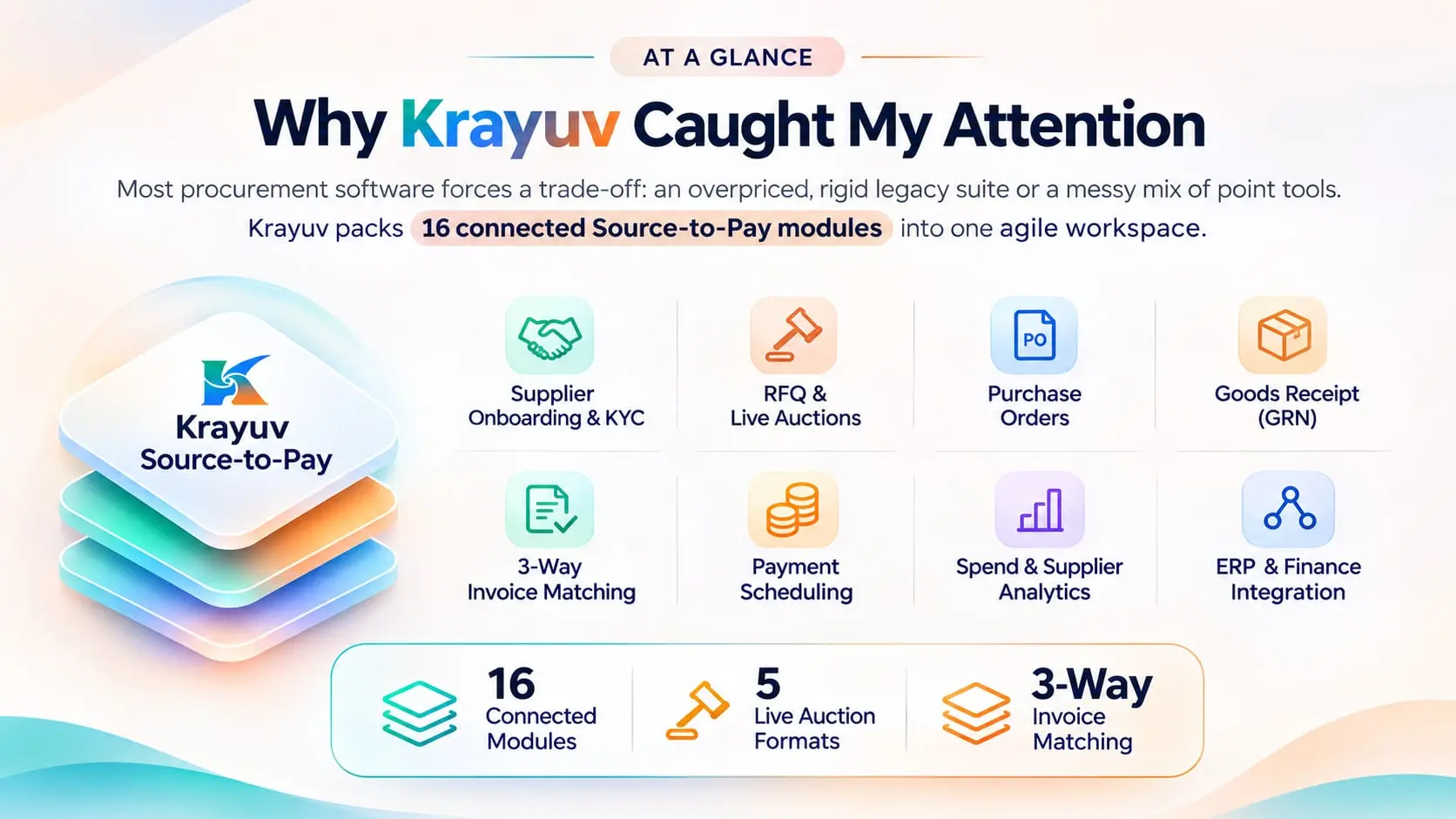
- connected Source-to-Pay modules in one workspace
- 16
- Krayuv
- live auction formats: Reverse, Forward, Dutch, Yankee and Competitive Benchmark
- 5
- krayuv.com
- RFQ evaluation modes: Commercial-only, Two-Envelope and Combined scoring
- 3
- krayuv.com
1. Krayuv features: what it gets right
Digging into Krayuv's architecture, it becomes obvious that the platform was designed around actual operational friction rather than executive slide decks. Several strengths immediately stand out:
- Unified Source-to-Pay (S2P, often called procure-to-pay) without legacy bloat. Many modern startups tackle only Procure-to-Pay (helping employees raise purchase requisitions once a vendor is already picked), leaving teams to run supplier discovery and bidding over email. Krayuv connects all 16 Source-to-Pay modules, from KYC-verified supplier onboarding and AI risk scanning to purchase orders, Goods Receipt Notes (GRNs) and payment scheduling, so data never falls into a black hole between departments.
- Serious auction and negotiation firepower. While most mid-market tools offer a basic quote form, Krayuv features a real-time bidding room with automatic time extensions, lead-change alerts and five distinct live auction formats (Reverse, Forward, Dutch, Yankee and Competitive Benchmark auctions). Paired with three structured RFQ evaluation modes (Commercial-only, Two-Envelope and Combined scoring), it brings institutional-grade buying discipline to teams that could never afford a Tier-1 suite.
- Exception-first 3-way invoice matching. Finance teams lose countless hours chasing minor mismatches between a purchase order, a goods receipt note and a supplier's bill. Krayuv uses OCR invoice capture, including built-in GSTIN extraction tailored for Indian tax compliance, to automatically reconcile all three documents. Clean invoices move straight toward scheduled payment, while discrepancies are routed to a dedicated exceptions dashboard.
- Built to coexist, not rip-and-replace. Developed within the procurement ecosystem, Krayuv is mobile-ready and engineered to plug into existing accounting and ERP setups rather than forcing companies to tear out their core financial systems.
2. Krayuv vs SAP Ariba, Coupa and point tools
In a market dominated by trillion-dollar tech ecosystems and well-funded unicorns, a leaner challenger only survives if its structural approach is fundamentally different. Krayuv separates itself from the pack in three clear ways:
- Speed of adoption vs. year-long implementations. Legacy suites like SAP Ariba or Oracle Procurement Cloud are powerful, but they often demand six- to eighteen-month rollouts and expensive third-party system integrators. Krayuv delivers comparable end-to-end workflow rigour with configurable approval hierarchies that operations teams can adopt in a fraction of the time.
- True bid-to-bill continuity vs. fragmented point tools. Niche e-auction platforms handle live bidding well, and lightweight spend tools handle basic PO approvals, but neither owns the handoff between them. Krayuv treats negotiated auction pricing, PO revisions, physical goods receipt and cash-flow forecasting as a single unbroken ledger.
- Grounded operational DNA. Unlike Silicon Valley tools built primarily for buying SaaS subscriptions and office laptops, Krayuv is purpose-built for businesses moving physical inventory, freight and industrial materials, where PO revisions, partial deliveries and tax compliance are daily realities.
3. Krayuv compared: feature table
| Capability | Billion-dollar legacy suites | Lightweight spend / point tools | Krayuv (krayuv.com) |
|---|---|---|---|
| Workflow scope | Full S2P, but heavy and complex | Narrow (either RFQs or basic POs) | Full 16-module Source-to-Pay in one workspace |
| Auction mechanics | Often gated behind costly add-ons | Basic reverse bids or manual Excel | 5 native live formats (Reverse, Forward, Dutch, Yankee, CBA) |
| Invoice and tax match | Strong, but slow to customise | Manual matching; high error risk | OCR + GSTIN 3-way matching with exception routing |
| Time to value | 6–18 months plus consulting fees | Fast setup, breaks at scale | Agile deployment with existing ERP integration |
4. Krayuv cons: where it needs to improve
No platform, especially a challenger taking on entrenched enterprise giants, is without blind spots. If Krayuv wants to convert early discovery into widespread enterprise adoption, there are four areas where it must sharpen its execution:
- Brand visibility and market trust signals. Standing out technically is only half the battle; enterprise CFOs are notoriously risk-averse. Compared to billion-dollar competitors backed by decades of analyst coverage, Krayuv needs far more public case studies, audited ROI benchmarks, security certifications (such as SOC 2 / ISO 27001 visibility) and customer testimonials front and centre.
- Self-serve product transparency. Today's B2B buyers want to test-drive software before booking a sales call. Offering interactive product tours, sandbox environments or transparent tiered pricing on krayuv.com would dramatically lower friction for mid-market teams evaluating the platform.
- Broader global tax and multi-currency localisation. While native GSTIN extraction and Indian tax compliance make Krayuv exceptionally strong for domestic and regional enterprises, scaling against global incumbents will require out-of-the-box VAT, e-invoicing and multi-entity cross-border compliance across North America, Europe and the Middle East.
- Pre-built plug-and-play ERP connectors and supplier network effects. Billion-dollar networks like SAP Business Network benefit from millions of pre-onboarded suppliers and one-click ERP connectors. Expanding pre-built integrations (for SAP S/4HANA, Oracle NetSuite, Microsoft Dynamics and Tally) alongside a shared supplier directory will accelerate onboarding for new buyers.
Questions readers ask
Frequently asked questions
What is Krayuv? Krayuv is an Indian Source-to-Pay (procure-to-pay) procurement platform. It combines 16 connected modules, from KYC-verified supplier onboarding, RFQs and live auctions to purchase orders, goods receipt, OCR 3-way invoice matching and payment scheduling, in one workspace.
What auction formats does Krayuv support? Five live formats: Reverse, Forward, Dutch, Yankee and Competitive Benchmark auctions. They run in a real-time bidding room with automatic time extensions and lead-change alerts, and RFQs can be scored Commercial-only, Two-Envelope or Combined.
Does Krayuv handle GST invoices? Yes. Its OCR invoice capture extracts GSTINs and reconciles each invoice against the purchase order and goods receipt note. Clean invoices move to scheduled payment, and mismatches go to an exceptions dashboard.
Is Krayuv an alternative to SAP Ariba or Coupa? For mid-market teams moving physical goods, it covers similar Source-to-Pay ground with faster adoption. It still trails the incumbents on global VAT and e-invoicing localisation, pre-built ERP connectors and supplier-network scale.
Does Krayuv integrate with ERP and accounting systems? Yes. Krayuv is designed to connect into existing accounting and ERP setups rather than replace them, so companies keep their core financial systems and use Krayuv for sourcing, purchasing and invoice matching.
5. Verdict: is Krayuv worth watching?

Coming across Krayuv is a refreshing reminder that the best enterprise software isn't always built by the loudest billion-dollar incumbent. By uniting 16 Source-to-Pay modules, five live auction formats, structured RFQ scoring and exception-first three-way invoice matching in a clean, practical system, Krayuv solves real procurement pain that far larger competitors still make unnecessarily complicated.
If the team behind Krayuv's procurement software pairs its strong product engineering with louder customer proof, self-serve onboarding and deeper global ERP connectors, it won't just remain a hidden gem. It will become a serious headache for the legacy giants.
Sources